
Available options are listed below:
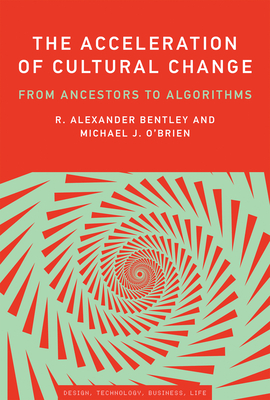
The Acceleration of Cultural Change: From Ancestors to Algorithms (Out of print)
| AUTHOR | Maeda, John; Bentley, R. Alexander; O'Brien, Michael J. et al. |
| PUBLISHER | MIT Press (08/25/2017) |
| PRODUCT TYPE | Hardcover (Hardcover) |
From our hunter-gatherer days, we humans evolved to be excellent throwers, chewers, and long-distance runners. We are highly social, crave Paleolithic snacks, and display some gendered difference resulting from mate selection. But we now find ourselves binge-viewing, texting while driving, and playing Minecraft. Only the collective acceleration of cultural and technological evolution explains this development. The evolutionary psychology of individuals--the drive for "food and sex"--explains some of our current habits, but our evolutionary success, Alex Bentley and Mike O'Brien explain, lies in our ability to learn cultural know-how and to teach it to the next generation. Today, we are following social media bots as much as we are learning from our ancestors. We are radically changing the way culture evolves.
Bentley and O'Brien describe how the transmission of culture has become vast and instantaneous across an Internet of people and devices, after millennia of local ancestral knowledge that evolved slowly. Long-evolved cultural knowledge is aggressively discounted by online algorithms, which prioritize popularity and recency. If children are learning more from Minecraft than from tradition, this is a profound shift in cultural evolution.
Bentley and O'Brien examine the broad and shallow model of cultural evolution seen today in the science of networks, prediction markets, and the explosion of digital information. They suggest that in the future, artificial intelligence could be put to work to solve the problem of information overload, learning to integrate concepts over the vast idea space of digitally stored information.
From our hunter-gatherer days, we humans evolved to be excellent throwers, chewers, and long-distance runners. We are highly social, crave Paleolithic snacks, and display some gendered difference resulting from mate selection. But we now find ourselves binge-viewing, texting while driving, and playing Minecraft. Only the collective acceleration of cultural and technological evolution explains this development. The evolutionary psychology of individuals--the drive for "food and sex"--explains some of our current habits, but our evolutionary success, Alex Bentley and Mike O'Brien explain, lies in our ability to learn cultural know-how and to teach it to the next generation. Today, we are following social media bots as much as we are learning from our ancestors. We are radically changing the way culture evolves.
Bentley and O'Brien describe how the transmission of culture has become vast and instantaneous across an Internet of people and devices, after millennia of local ancestral knowledge that evolved slowly. Long-evolved cultural knowledge is aggressively discounted by online algorithms, which prioritize popularity and recency. If children are learning more from Minecraft than from tradition, this is a profound shift in cultural evolution.
Bentley and O'Brien examine the broad and shallow model of cultural evolution seen today in the science of networks, prediction markets, and the explosion of digital information. They suggest that in the future, artificial intelligence could be put to work to solve the problem of information overload, learning to integrate concepts over the vast idea space of digitally stored information.