
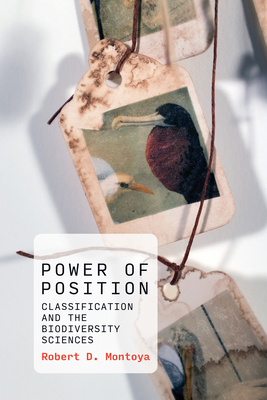
Power of Position: Classification and the Biodiversity Sciences
| AUTHOR | Montoya, Robert D. |
| PUBLISHER | MIT Press (05/24/2022) |
| PRODUCT TYPE | Paperback (Paperback) |
Description
How biodiversity classification, with its ranking of species, has social and political implications as well as implications for the field of information studies.
The idea that species live in nature as pure and clear-cut named individuals is a fiction, as scientists well know. According to Robert D. Montoya, classifications are powerful mechanisms and we must better attend to the machinations of power inherent in them, as well as to how the effects of this power proliferate beyond the boundaries of their original intent. We must acknowledge the many ways our classifications are implicated in environmental, ecological, and social justice work--and information specialists must play a role in updating our notions of what it means to classify. In Power of Position, Montoya shows how classifications are systems that relate one entity with other entities, requiring those who construct a system to value an entity's relative importance--by way of its position--within a system of other entities. These practices, says Montoya, are important ways of constituting and exerting power. Classification also has very real-world consequences. An animal classified as protected and endangered, for example, is protected by law. Montoya also discusses the Catalogue of Life, a new kind of composite classification that reconciles many local ("traditional") taxonomies, forming a unified taxonomic backbone structure for organizing biological data. Finally, he shows how the theories of information studies are applicable to realms far beyond those of biological classification.
The idea that species live in nature as pure and clear-cut named individuals is a fiction, as scientists well know. According to Robert D. Montoya, classifications are powerful mechanisms and we must better attend to the machinations of power inherent in them, as well as to how the effects of this power proliferate beyond the boundaries of their original intent. We must acknowledge the many ways our classifications are implicated in environmental, ecological, and social justice work--and information specialists must play a role in updating our notions of what it means to classify. In Power of Position, Montoya shows how classifications are systems that relate one entity with other entities, requiring those who construct a system to value an entity's relative importance--by way of its position--within a system of other entities. These practices, says Montoya, are important ways of constituting and exerting power. Classification also has very real-world consequences. An animal classified as protected and endangered, for example, is protected by law. Montoya also discusses the Catalogue of Life, a new kind of composite classification that reconciles many local ("traditional") taxonomies, forming a unified taxonomic backbone structure for organizing biological data. Finally, he shows how the theories of information studies are applicable to realms far beyond those of biological classification.
Show More
Product Format
Product Details
ISBN-13:
9780262045278
ISBN-10:
0262045273
Binding:
Paperback or Softback (Trade Paperback (Us))
Content Language:
English
More Product Details
Page Count:
272
Carton Quantity:
40
Product Dimensions:
5.98 x 0.71 x 8.90 inches
Weight:
0.80 pound(s)
Feature Codes:
Bibliography,
Index,
Price on Product,
Illustrated
Country of Origin:
US
Subject Information
BISAC Categories
Science | Life Sciences - Biological Diversity
Science | Library & Information Science - Cataloging & Classification
Science | Reference
Dewey Decimal:
570.12
Library of Congress Control Number:
2021033972
Descriptions, Reviews, Etc.
publisher marketing
How biodiversity classification, with its ranking of species, has social and political implications as well as implications for the field of information studies.
The idea that species live in nature as pure and clear-cut named individuals is a fiction, as scientists well know. According to Robert D. Montoya, classifications are powerful mechanisms and we must better attend to the machinations of power inherent in them, as well as to how the effects of this power proliferate beyond the boundaries of their original intent. We must acknowledge the many ways our classifications are implicated in environmental, ecological, and social justice work--and information specialists must play a role in updating our notions of what it means to classify. In Power of Position, Montoya shows how classifications are systems that relate one entity with other entities, requiring those who construct a system to value an entity's relative importance--by way of its position--within a system of other entities. These practices, says Montoya, are important ways of constituting and exerting power. Classification also has very real-world consequences. An animal classified as protected and endangered, for example, is protected by law. Montoya also discusses the Catalogue of Life, a new kind of composite classification that reconciles many local ("traditional") taxonomies, forming a unified taxonomic backbone structure for organizing biological data. Finally, he shows how the theories of information studies are applicable to realms far beyond those of biological classification.
The idea that species live in nature as pure and clear-cut named individuals is a fiction, as scientists well know. According to Robert D. Montoya, classifications are powerful mechanisms and we must better attend to the machinations of power inherent in them, as well as to how the effects of this power proliferate beyond the boundaries of their original intent. We must acknowledge the many ways our classifications are implicated in environmental, ecological, and social justice work--and information specialists must play a role in updating our notions of what it means to classify. In Power of Position, Montoya shows how classifications are systems that relate one entity with other entities, requiring those who construct a system to value an entity's relative importance--by way of its position--within a system of other entities. These practices, says Montoya, are important ways of constituting and exerting power. Classification also has very real-world consequences. An animal classified as protected and endangered, for example, is protected by law. Montoya also discusses the Catalogue of Life, a new kind of composite classification that reconciles many local ("traditional") taxonomies, forming a unified taxonomic backbone structure for organizing biological data. Finally, he shows how the theories of information studies are applicable to realms far beyond those of biological classification.
Show More
Your Price
$39.60