
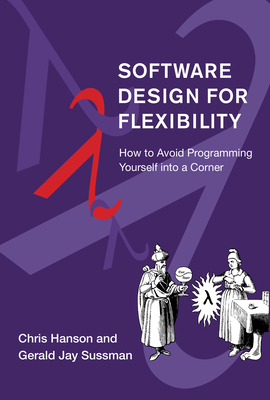
Software Design for Flexibility: How to Avoid Programming Yourself Into a Corner
| AUTHOR | Sussman, Gerald Jay; Hanson, Chris; Sussman, Gerald Jay |
| PUBLISHER | MIT Press (03/09/2021) |
| PRODUCT TYPE | Hardcover (Hardcover) |
Description
Strategies for building large systems that can be easily adapted for new situations with only minor programming modifications. Time pressures encourage programmers to write code that works well for a narrow purpose, with no room to grow. But the best systems are evolvable; they can be adapted for new situations by adding code, rather than changing the existing code. The authors describe techniques they have found effective--over their combined 100-plus years of programming experience--that will help programmers avoid programming themselves into corners. The authors explore ways to enhance flexibility by:
Organizing systems using combinators to compose mix-and-match parts, ranging from small functions to whole arithmetics, with standardized interfaces Augmenting data with independent annotation layers, such as units of measurement or provenance Combining independent pieces of partial information using unification or propagation Separating control structure from problem domain with domain models, rule systems and pattern matching, propagation, and dependency-directed backtracking Extending the programming language, using dynamically extensible evaluators
Show More
Product Format
Product Details
ISBN-13:
9780262045490
ISBN-10:
0262045494
Binding:
Hardback or Cased Book (Sewn)
Content Language:
English
More Product Details
Page Count:
448
Carton Quantity:
24
Product Dimensions:
6.00 x 1.00 x 9.10 inches
Weight:
1.60 pound(s)
Feature Codes:
Bibliography,
Index,
Price on Product,
Illustrated
Country of Origin:
US
Subject Information
BISAC Categories
Computers | Computer Science
Computers | Software Development & Engineering - Systems Analysis & Desi
Computers | Programming - Object Oriented
Dewey Decimal:
005.111
Library of Congress Control Number:
2020040688
Descriptions, Reviews, Etc.
publisher marketing
Strategies for building large systems that can be easily adapted for new situations with only minor programming modifications. Time pressures encourage programmers to write code that works well for a narrow purpose, with no room to grow. But the best systems are evolvable; they can be adapted for new situations by adding code, rather than changing the existing code. The authors describe techniques they have found effective--over their combined 100-plus years of programming experience--that will help programmers avoid programming themselves into corners. The authors explore ways to enhance flexibility by:
Organizing systems using combinators to compose mix-and-match parts, ranging from small functions to whole arithmetics, with standardized interfaces Augmenting data with independent annotation layers, such as units of measurement or provenance Combining independent pieces of partial information using unification or propagation Separating control structure from problem domain with domain models, rule systems and pattern matching, propagation, and dependency-directed backtracking Extending the programming language, using dynamically extensible evaluators
Show More
Your Price
$54.45