
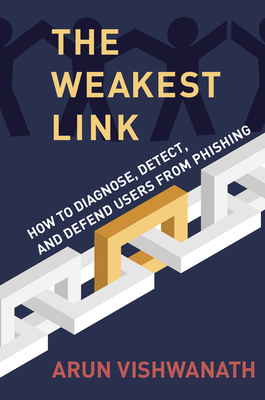
The Weakest Link: How to Diagnose, Detect, and Defend Users from Phishing
| AUTHOR | Vishwanath, Arun; Vishwanath, Arun |
| PUBLISHER | MIT Press (08/16/2022) |
| PRODUCT TYPE | Hardcover (Hardcover) |
Description
An expert in cybersecurity lays out an evidence-based approach for assessing user cyber risk and achieving organizational cyber resilience. Phishing is the single biggest threat to cybersecurity, persuading even experienced users to click on hyperlinks and attachments in emails that conceal malware. Phishing has been responsible for every major cyber breach, from the infamous Sony hack in 2014 to the 2017 hack of the Democratic National Committee and the more recent Colonial Pipleline breach. The cybersecurity community's response has been intensive user training (often followed by user blaming), which has proven completely ineffective: the hacks keep coming. In The Weakest Link, cybersecurity expert Arun Vishwanath offers a new, evidence-based approach for detecting and defending against phishing--an approach that doesn't rely on continual training and retraining but provides a way to diagnose user vulnerability. Vishwanath explains how organizations can build a culture of cyber safety. He presents a Cyber Risk Survey (CRS) to help managers understand which users are at risk and why. Underlying CRS is the Suspicion, Cognition, Automaticity Model (SCAM), which specifies the user thoughts and actions that lead to either deception by or detection of phishing come-ons. He describes in detail how to implement these frameworks, discussing relevant insights from cognitive and behavioral science, and then presents case studies of organizations that have successfully deployed the CRS to achieve cyber resilience. These range from a growing wealth management company with twenty regional offices to a small Pennsylvania nonprofit with forty-five employees. The Weakest Link will revolutionize the way managers approach cyber security, replacing the current one-size-fits-all methodology with a strategy that targets specific user vulnerabilities.
Show More
Product Format
Product Details
ISBN-13:
9780262047494
ISBN-10:
0262047497
Binding:
Hardback or Cased Book (Sewn)
Content Language:
English
More Product Details
Page Count:
272
Carton Quantity:
24
Product Dimensions:
6.30 x 0.84 x 9.24 inches
Weight:
1.16 pound(s)
Feature Codes:
Bibliography,
Price on Product
Country of Origin:
US
Subject Information
BISAC Categories
Computers | Internet - Online Safety & Privacy
Computers | Data Transmission Systems - General
Computers | Computer Literacy
Dewey Decimal:
364.168
Library of Congress Control Number:
2021060548
Descriptions, Reviews, Etc.
publisher marketing
An expert in cybersecurity lays out an evidence-based approach for assessing user cyber risk and achieving organizational cyber resilience. Phishing is the single biggest threat to cybersecurity, persuading even experienced users to click on hyperlinks and attachments in emails that conceal malware. Phishing has been responsible for every major cyber breach, from the infamous Sony hack in 2014 to the 2017 hack of the Democratic National Committee and the more recent Colonial Pipleline breach. The cybersecurity community's response has been intensive user training (often followed by user blaming), which has proven completely ineffective: the hacks keep coming. In The Weakest Link, cybersecurity expert Arun Vishwanath offers a new, evidence-based approach for detecting and defending against phishing--an approach that doesn't rely on continual training and retraining but provides a way to diagnose user vulnerability. Vishwanath explains how organizations can build a culture of cyber safety. He presents a Cyber Risk Survey (CRS) to help managers understand which users are at risk and why. Underlying CRS is the Suspicion, Cognition, Automaticity Model (SCAM), which specifies the user thoughts and actions that lead to either deception by or detection of phishing come-ons. He describes in detail how to implement these frameworks, discussing relevant insights from cognitive and behavioral science, and then presents case studies of organizations that have successfully deployed the CRS to achieve cyber resilience. These range from a growing wealth management company with twenty regional offices to a small Pennsylvania nonprofit with forty-five employees. The Weakest Link will revolutionize the way managers approach cyber security, replacing the current one-size-fits-all methodology with a strategy that targets specific user vulnerabilities.
Show More
List Price $29.95
Your Price
$29.65