
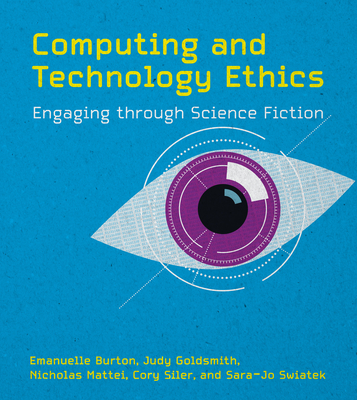
Computing and Technology Ethics: Engaging Through Science Fiction
| AUTHOR | Burton, Emanuelle; Mattei, Nicholas; Goldsmith, Judy |
| PUBLISHER | MIT Press (02/14/2023) |
| PRODUCT TYPE | Hardcover (Hardcover) |
Description
A new approach to teaching computing and technology ethics using science fiction stories. Should autonomous weapons be legal? Will we be cared for by robots in our old age? Does the efficiency of online banking outweigh the risk of theft? From communication to travel to medical care, computing technologies have transformed our daily lives, for better and for worse. But how do we know when a new development comes at too high a cost? Using science fiction stories as case studies of ethical ambiguity, this engaging textbook offers a comprehensive introduction to ethical theory and its application to contemporary developments in technology and computer science.
Computing and Technology Ethics: Engaging through Science Fiction first introduces the major ethical frameworks: deontology, utilitarianism, virtue ethics, communitarianism, and the modern responses of responsibility ethics, feminist ethics, and capability ethics. It then applies these frameworks to many of the modern issues arising in technology ethics including privacy, computing, and artificial intelligence. A corresponding anthology of science fiction brings these quandaries to life and challenges students to ask ethical questions of themselves and their work.
Computing and Technology Ethics: Engaging through Science Fiction first introduces the major ethical frameworks: deontology, utilitarianism, virtue ethics, communitarianism, and the modern responses of responsibility ethics, feminist ethics, and capability ethics. It then applies these frameworks to many of the modern issues arising in technology ethics including privacy, computing, and artificial intelligence. A corresponding anthology of science fiction brings these quandaries to life and challenges students to ask ethical questions of themselves and their work.
- Uses science fiction case studies to make ethics education engaging and fun
- Trains students to recognize, evaluate, and respond to ethical problems as they arise
- Features anthology of short stories from internationally acclaimed writers including Ken Liu, Elizabeth Bear, Paolo Bacigalupi, and T. C. Boyle to animate ethical challenges in computing technology
- Written by interdisciplinary author team of computer scientists and ethical theorists
- Includes a robust suite of instructor resources, such as pedagogy guides, story frames, and reflection questions
Show More
Product Format
Product Details
ISBN-13:
9780262048064
ISBN-10:
026204806X
Binding:
Hardback or Cased Book (Sewn)
Content Language:
English
More Product Details
Page Count:
504
Carton Quantity:
10
Product Dimensions:
8.27 x 1.42 x 9.06 inches
Weight:
2.15 pound(s)
Feature Codes:
Bibliography,
Index,
Price on Product
Country of Origin:
US
Subject Information
BISAC Categories
Computers | Computer Science
Computers | Social Aspects
Computers | Ethics & Moral Philosophy
Dewey Decimal:
170
Library of Congress Control Number:
2022018577
Descriptions, Reviews, Etc.
publisher marketing
A new approach to teaching computing and technology ethics using science fiction stories. Should autonomous weapons be legal? Will we be cared for by robots in our old age? Does the efficiency of online banking outweigh the risk of theft? From communication to travel to medical care, computing technologies have transformed our daily lives, for better and for worse. But how do we know when a new development comes at too high a cost? Using science fiction stories as case studies of ethical ambiguity, this engaging textbook offers a comprehensive introduction to ethical theory and its application to contemporary developments in technology and computer science.
Computing and Technology Ethics: Engaging through Science Fiction first introduces the major ethical frameworks: deontology, utilitarianism, virtue ethics, communitarianism, and the modern responses of responsibility ethics, feminist ethics, and capability ethics. It then applies these frameworks to many of the modern issues arising in technology ethics including privacy, computing, and artificial intelligence. A corresponding anthology of science fiction brings these quandaries to life and challenges students to ask ethical questions of themselves and their work.
Computing and Technology Ethics: Engaging through Science Fiction first introduces the major ethical frameworks: deontology, utilitarianism, virtue ethics, communitarianism, and the modern responses of responsibility ethics, feminist ethics, and capability ethics. It then applies these frameworks to many of the modern issues arising in technology ethics including privacy, computing, and artificial intelligence. A corresponding anthology of science fiction brings these quandaries to life and challenges students to ask ethical questions of themselves and their work.
- Uses science fiction case studies to make ethics education engaging and fun
- Trains students to recognize, evaluate, and respond to ethical problems as they arise
- Features anthology of short stories from internationally acclaimed writers including Ken Liu, Elizabeth Bear, Paolo Bacigalupi, and T. C. Boyle to animate ethical challenges in computing technology
- Written by interdisciplinary author team of computer scientists and ethical theorists
- Includes a robust suite of instructor resources, such as pedagogy guides, story frames, and reflection questions
Show More
Your Price
$84.15