
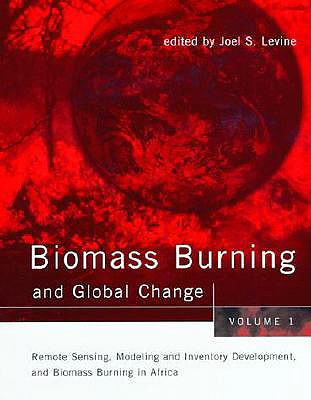
Biomass Burning and Global Change, Volume 1: Remote Sensing, Modeling and Inventory Development, and Biomass Burning in Africa
| PUBLISHER | MIT Press (01/07/1997) |
| PRODUCT TYPE | Hardcover (Hardcover) |
The 1989 report of the National Research Council, Global Change and Our Common Future states: Our planet and global environment are witnessing the most profound changes in the brief history of the human species. Human activity is the major agent of those changes--depletion of stratospheric ozone, the threat of global warming, deforestation, acid precipitation, the extinction of species, and others that have not become apparent. One human activity that leads to all of these global changes is the burning of the world's living and dead vegetation. And human-initiated biomass burning has increased significantly over the last century. Biomass Burning and Global Change assesses the impact of biomass burning as a driver for global change. The two volumes bring together the most recent results of a massive climatic research project in over 80 contributions by more than 200 scientists representing a dozen different countries. The contributions are divided into the tropical, temperate, and boreal regions of the world, and many of the contributors are from countries where burning is widespread. All aspects of biomass burning are covered--from fire ecology to atmospheric chemistry and climate. Topics include the remote sensing of fires from space, the characteristics and ecology of fire, gaseous and particulate emissions from burning, and the impact of these emissions on the chemistry of the troposphere and stratosphere and on global climate. There are also results of recent national and international experiments on biomass burning, including the international South African Fire-Atmosphere Research Initiative (SAFARI) and Bor Forest Island Experiment in Siberia, part of the Fire Research Campaign Asia-North (FIRESCAN), and the U.S. Smoke, Clouds, and Radiation (SCAR) Experiment. Several chapters deal with the Kuwaiti oil fires and their environmental impacts.
The 1989 report of the National Research Council, Global Change and Our Common Future states: Our planet and global environment are witnessing the most profound changes in the brief history of the human species. Human activity is the major agent of those changes--depletion of stratospheric ozone, the threat of global warming, deforestation, acid precipitation, the extinction of species, and others that have not become apparent. One human activity that leads to all of these global changes is the burning of the world's living and dead vegetation. And human-initiated biomass burning has increased significantly over the last century. Biomass Burning and Global Change assesses the impact of biomass burning as a driver for global change. The two volumes bring together the most recent results of a massive climatic research project in over 80 contributions by more than 200 scientists representing a dozen different countries. The contributions are divided into the tropical, temperate, and boreal regions of the world, and many of the contributors are from countries where burning is widespread. All aspects of biomass burning are covered--from fire ecology to atmospheric chemistry and climate. Topics include the remote sensing of fires from space, the characteristics and ecology of fire, gaseous and particulate emissions from burning, and the impact of these emissions on the chemistry of the troposphere and stratosphere and on global climate. There are also results of recent national and international experiments on biomass burning, including the international South African Fire-Atmosphere Research Initiative (SAFARI) and Bor Forest Island Experiment in Siberia, part of the Fire Research Campaign Asia-North (FIRESCAN), and the U.S. Smoke, Clouds, and Radiation (SCAR) Experiment. Several chapters deal with the Kuwaiti oil fires and their environmental impacts.