
Available options are listed below:
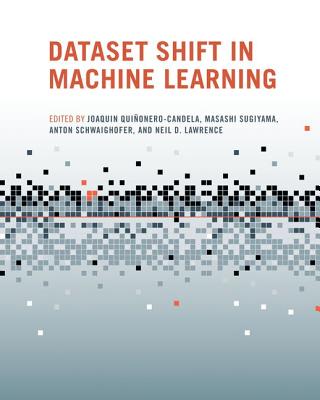
Dataset Shift in Machine Learning (Out of print)
| PUBLISHER | MIT Press (02/01/2009) |
| PRODUCT TYPE | Hardcover (Hardcover) |
Dataset shift is a common problem in predictive modeling that occurs when the joint distribution of inputs and outputs differs between training and test stages. Covariate shift, a particular case of dataset shift, occurs when only the input distribution changes. Dataset shift is present in most practical applications, for reasons ranging from the bias introduced by experimental design to the irreproducibility of the testing conditions at training time. (An example is -email spam filtering, which may fail to recognize spam that differs in form from the spam the automatic filter has been built on.) Despite this, and despite the attention given to the apparently similar problems of semi-supervised learning and active learning, dataset shift has received relatively little attention in the machine learning community until recently. This volume offers an overview of current efforts to deal with dataset and covariate shift. The chapters offer a mathematical and philosophical introduction to the problem, place dataset shift in relationship to transfer learning, transduction, local learning, active learning, and semi-supervised learning, provide theoretical views of dataset and covariate shift (including decision theoretic and Bayesian perspectives), and present algorithms for covariate shift.
Contributors
Shai Ben-David, Steffen Bickel, Karsten Borgwardt, Michael Br ckner, David Corfield, Amir Globerson, Arthur Gretton, Lars Kai Hansen, Matthias Hein, Jiayuan Huang, Choon Hui Teo, Takafumi Kanamori, Klaus-Robert M ller, Sam Roweis, Neil Rubens, Tobias Scheffer, Marcel Schmittfull, Bernhard Sch lkopf Hidetoshi Shimodaira, Alex Smola, Amos Storkey, Masashi Sugiyama
Dataset shift is a common problem in predictive modeling that occurs when the joint distribution of inputs and outputs differs between training and test stages. Covariate shift, a particular case of dataset shift, occurs when only the input distribution changes. Dataset shift is present in most practical applications, for reasons ranging from the bias introduced by experimental design to the irreproducibility of the testing conditions at training time. (An example is -email spam filtering, which may fail to recognize spam that differs in form from the spam the automatic filter has been built on.) Despite this, and despite the attention given to the apparently similar problems of semi-supervised learning and active learning, dataset shift has received relatively little attention in the machine learning community until recently. This volume offers an overview of current efforts to deal with dataset and covariate shift. The chapters offer a mathematical and philosophical introduction to the problem, place dataset shift in relationship to transfer learning, transduction, local learning, active learning, and semi-supervised learning, provide theoretical views of dataset and covariate shift (including decision theoretic and Bayesian perspectives), and present algorithms for covariate shift.
Contributors
Shai Ben-David, Steffen Bickel, Karsten Borgwardt, Michael Br ckner, David Corfield, Amir Globerson, Arthur Gretton, Lars Kai Hansen, Matthias Hein, Jiayuan Huang, Choon Hui Teo, Takafumi Kanamori, Klaus-Robert M ller, Sam Roweis, Neil Rubens, Tobias Scheffer, Marcel Schmittfull, Bernhard Sch lkopf Hidetoshi Shimodaira, Alex Smola, Amos Storkey, Masashi Sugiyama