
Available options are listed below:
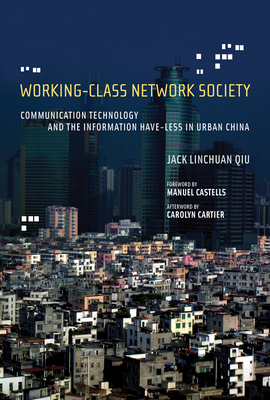
Working-Class Network Society: Communication Technology and the Information Have-Less in Urban China (Out of print)
| AUTHOR | Cartier, Carolyn; Castells, Manuel; Castells, Manuel et al. |
| PUBLISHER | MIT Press (03/01/2009) |
| PRODUCT TYPE | Hardcover (Hardcover) |
An examination of how the availability of low-end information and communication technology has provided a basis for the emergence of a working-class network society in China.
The idea of the "digital divide," the great social division between information haves and have-nots, has dominated policy debates and scholarly analysis since the 1990s. In Working-Class Network Society, Jack Linchuan Qiu describes a more complex social and technological reality in a newly mobile, urbanizing China. Qiu argues that as inexpensive Internet and mobile phone services become available and are closely integrated with the everyday work and life of low-income communities, they provide a critical seedbed for the emergence of a new working class of "network labor" crucial to China's economic boom. Between the haves and have-nots, writes Qiu, are the information "have-less" migrants, laid-off workers, micro-entrepreneurs, retirees, youth, and others, increasingly connected by cybercaf s, prepaid service, and used mobile phones. A process of class formation has begun that has important implications for working-class network society in China and beyond. Qiu brings class back into the scholarly discussion, not as a secondary factor but as an essential dimension in our understanding of communication technology as it is shaped in the vast, industrializing society of China. Basing his analysis on his more than five years of empirical research conducted in twenty cities, Qiu examines technology and class, networked connectivity and public policy, in the context of massive urban reforms that affect the new working class disproportionately. The transformation of Chinese society, writes Qiu, is emblematic of the new technosocial reality emerging in much of the Global South.
An examination of how the availability of low-end information and communication technology has provided a basis for the emergence of a working-class network society in China.
The idea of the "digital divide," the great social division between information haves and have-nots, has dominated policy debates and scholarly analysis since the 1990s. In Working-Class Network Society, Jack Linchuan Qiu describes a more complex social and technological reality in a newly mobile, urbanizing China. Qiu argues that as inexpensive Internet and mobile phone services become available and are closely integrated with the everyday work and life of low-income communities, they provide a critical seedbed for the emergence of a new working class of "network labor" crucial to China's economic boom. Between the haves and have-nots, writes Qiu, are the information "have-less" migrants, laid-off workers, micro-entrepreneurs, retirees, youth, and others, increasingly connected by cybercaf s, prepaid service, and used mobile phones. A process of class formation has begun that has important implications for working-class network society in China and beyond. Qiu brings class back into the scholarly discussion, not as a secondary factor but as an essential dimension in our understanding of communication technology as it is shaped in the vast, industrializing society of China. Basing his analysis on his more than five years of empirical research conducted in twenty cities, Qiu examines technology and class, networked connectivity and public policy, in the context of massive urban reforms that affect the new working class disproportionately. The transformation of Chinese society, writes Qiu, is emblematic of the new technosocial reality emerging in much of the Global South.