
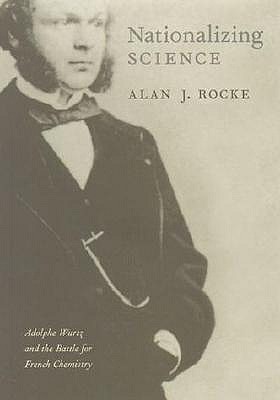
Nationalizing Science: Adolphe Wurtz and the Battle for French Chemistry
| AUTHOR | Buchwald, Jed Z.; Rocke, Alan J. |
| PUBLISHER | MIT Press (11/08/2000) |
| PRODUCT TYPE | Hardcover (Hardcover) |
After looking at the early careers of Wurtz's two mentors, Liebig and Jean-Baptiste Dumas, Rocke describes Wurtz's life and career in the politically complex period leading up to 1853. He then discusses the turning point in Wurtz's intellectual life--his conversion to the reformed chemistry of Laurent, Gerhardt, and Williamson--and his efforts to persuade his colleagues of the advantages of the new system.
In 1869, Adolphe Wurtz (1817-1884) called chemistry a French science. In fact, however, Wurtz was the most internationalist of French chemists. Born in Strasbourg and educated partly in the laboratory of the great Justus Liebig, he spent his career in Paris, where he devoted himself to introducing German ideas into French scientific circles. His life therefore provides an excellent vehicle for considering the divergent trajectories of French and German chemistry--and, by extension, French and German science--during this crucial period. After looking at the early careers of Wurtz's two mentors, Liebig and Jean-Baptiste Dumas, Rocke describes Wurtz's life and career in the politically complex period leading up to 1853. He then discusses the turning point in Wurtz's intellectual life--his conversion to the reformed chemistry of Laurent, Gerhardt, and Williamson--and his efforts (social and political, as well as scientific) to persuade his colleagues of the advantages of the new system. He looks at political patronage, or the lack thereof, and at the insufficient material support from the French government, during the middle decades of the century. From there Rocke goes on to examine the rivalry between Wurtz and Marcellin Berthelot, the debate over atoms versus equivalents, and the reasons for Wurtz's failure to win acceptance for his ideas. The story offers insights into the changing status of science in this period, and helps to explain the eventual course of both French and German chemistry.
After looking at the early careers of Wurtz's two mentors, Liebig and Jean-Baptiste Dumas, Rocke describes Wurtz's life and career in the politically complex period leading up to 1853. He then discusses the turning point in Wurtz's intellectual life--his conversion to the reformed chemistry of Laurent, Gerhardt, and Williamson--and his efforts to persuade his colleagues of the advantages of the new system.
In 1869, Adolphe Wurtz (1817-1884) called chemistry a French science. In fact, however, Wurtz was the most internationalist of French chemists. Born in Strasbourg and educated partly in the laboratory of the great Justus Liebig, he spent his career in Paris, where he devoted himself to introducing German ideas into French scientific circles. His life therefore provides an excellent vehicle for considering the divergent trajectories of French and German chemistry--and, by extension, French and German science--during this crucial period. After looking at the early careers of Wurtz's two mentors, Liebig and Jean-Baptiste Dumas, Rocke describes Wurtz's life and career in the politically complex period leading up to 1853. He then discusses the turning point in Wurtz's intellectual life--his conversion to the reformed chemistry of Laurent, Gerhardt, and Williamson--and his efforts (social and political, as well as scientific) to persuade his colleagues of the advantages of the new system. He looks at political patronage, or the lack thereof, and at the insufficient material support from the French government, during the middle decades of the century. From there Rocke goes on to examine the rivalry between Wurtz and Marcellin Berthelot, the debate over atoms versus equivalents, and the reasons for Wurtz's failure to win acceptance for his ideas. The story offers insights into the changing status of science in this period, and helps to explain the eventual course of both French and German chemistry.