
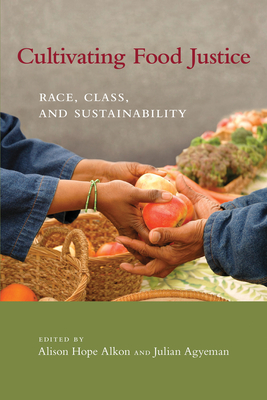
Cultivating Food Justice: Race, Class, and Sustainability
| PUBLISHER | MIT Press (10/07/2011) |
| PRODUCT TYPE | Paperback (Paperback) |
Popularized by such best-selling authors as Michael Pollan, Barbara Kingsolver, and Eric Schlosser, a growing food movement urges us to support sustainable agriculture by eating fresh food produced on local family farms. But many low-income neighborhoods and communities of color have been systematically deprived of access to healthy and sustainable food. These communities have been actively prevented from producing their own food and often live in "food deserts" where fast food is more common than fresh food. Cultivating Food Justice describes their efforts to envision and create environmentally sustainable and socially just alternatives to the food system.
Bringing together insights from studies of environmental justice, sustainable agriculture, critical race theory, and food studies, Cultivating Food Justice highlights the ways race and class inequalities permeate the food system, from production to distribution to consumption. The studies offered in the book explore a range of important issues, including agricultural and land use policies that systematically disadvantage Native American, African American, Latino/a, and Asian American farmers and farmworkers; access problems in both urban and rural areas; efforts to create sustainable local food systems in low-income communities of color; and future directions for the food justice movement. These diverse accounts of the relationships among food, environmentalism, justice, race, and identity will help guide efforts to achieve a just and sustainable agriculture.
Popularized by such best-selling authors as Michael Pollan, Barbara Kingsolver, and Eric Schlosser, a growing food movement urges us to support sustainable agriculture by eating fresh food produced on local family farms. But many low-income neighborhoods and communities of color have been systematically deprived of access to healthy and sustainable food. These communities have been actively prevented from producing their own food and often live in "food deserts" where fast food is more common than fresh food. Cultivating Food Justice describes their efforts to envision and create environmentally sustainable and socially just alternatives to the food system.
Bringing together insights from studies of environmental justice, sustainable agriculture, critical race theory, and food studies, Cultivating Food Justice highlights the ways race and class inequalities permeate the food system, from production to distribution to consumption. The studies offered in the book explore a range of important issues, including agricultural and land use policies that systematically disadvantage Native American, African American, Latino/a, and Asian American farmers and farmworkers; access problems in both urban and rural areas; efforts to create sustainable local food systems in low-income communities of color; and future directions for the food justice movement. These diverse accounts of the relationships among food, environmentalism, justice, race, and identity will help guide efforts to achieve a just and sustainable agriculture.