
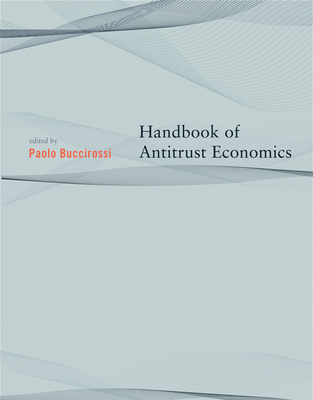
Handbook of Antitrust Economics
| PUBLISHER | MIT Press (04/01/2008) |
| PRODUCT TYPE | Paperback (Paperback) |
Experts examine the application of economic theory to antitrust issues in both the United States and Europe, discussing mergers, agreements, abuses of dominance, and the impact of market features.
Over the past twenty years, economic theory has begun to play a central role in antitrust matters. In earlier days, the application of antitrust rules was viewed almost entirely in formal terms; now it is widely accepted that the proper interpretation of these rules requires an understanding of how markets work and how firms can alter their efficient functioning. The Handbook of Antitrust Economics offers scholars, students, administrators, courts, companies, and lawyers the economist's view of the subject, describing the application of newly developed theoretical models and improved empirical methods to antitrust and competition law in both the United States and the European Union. (The book uses the U.S. term "antitrust law" and the European "competition law" interchangeably, emphasizing the commonalities between the two jurisdictions.)
After a general discussion of the use of empirical methods in antitrust cases, the Handbook covers mergers, agreements, abuses of dominance (or unilateral conducts), and market features that affect the way firms compete. Chapters examine such topics as analyzing the competitive effects of both horizontal and vertical mergers, detecting and preventing cartels, theoretical and empirical analysis of vertical restraints, state aids, the relationship of competition law to the defense of intellectual property, and the application of antitrust law to "bidding markets," network industries, and two-sided markets.
Contributors
Mark Armstrong, Jonathan B. Baker, Timothy F. Bresnahan, Paulo Buccirossi, Nicholas Economides, Hans W. Friederiszick, Luke M. Froeb, Richard J. Gilbert, Joseph E. Harrington, Jr., Paul Klemperer, Kai-Uwe Kuhn, Francine Lafontaine, Damien J. Neven, Patrick Rey, Michael H. Riordan, Jean-Charles Rochet, Lars-Hendrick R ller, Margaret Slade, Giancarlo Spagnolo, Jean Tirole, Thibaud Verg , Vincent Verouden, John Vickers, Gregory J. Werden
Experts examine the application of economic theory to antitrust issues in both the United States and Europe, discussing mergers, agreements, abuses of dominance, and the impact of market features.
Over the past twenty years, economic theory has begun to play a central role in antitrust matters. In earlier days, the application of antitrust rules was viewed almost entirely in formal terms; now it is widely accepted that the proper interpretation of these rules requires an understanding of how markets work and how firms can alter their efficient functioning. The Handbook of Antitrust Economics offers scholars, students, administrators, courts, companies, and lawyers the economist's view of the subject, describing the application of newly developed theoretical models and improved empirical methods to antitrust and competition law in both the United States and the European Union. (The book uses the U.S. term "antitrust law" and the European "competition law" interchangeably, emphasizing the commonalities between the two jurisdictions.)
After a general discussion of the use of empirical methods in antitrust cases, the Handbook covers mergers, agreements, abuses of dominance (or unilateral conducts), and market features that affect the way firms compete. Chapters examine such topics as analyzing the competitive effects of both horizontal and vertical mergers, detecting and preventing cartels, theoretical and empirical analysis of vertical restraints, state aids, the relationship of competition law to the defense of intellectual property, and the application of antitrust law to "bidding markets," network industries, and two-sided markets.
Contributors
Mark Armstrong, Jonathan B. Baker, Timothy F. Bresnahan, Paulo Buccirossi, Nicholas Economides, Hans W. Friederiszick, Luke M. Froeb, Richard J. Gilbert, Joseph E. Harrington, Jr., Paul Klemperer, Kai-Uwe Kuhn, Francine Lafontaine, Damien J. Neven, Patrick Rey, Michael H. Riordan, Jean-Charles Rochet, Lars-Hendrick R ller, Margaret Slade, Giancarlo Spagnolo, Jean Tirole, Thibaud Verg , Vincent Verouden, John Vickers, Gregory J. Werden