
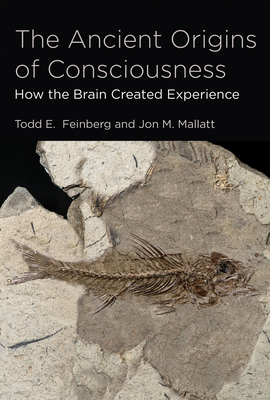
The Ancient Origins of Consciousness: How the Brain Created Experience /]ctodd E. Feinberg, and Jon M. Mallatt
| AUTHOR | Mallatt, Jon M.; Feinberg, Todd E.; Mallatt, Jon M. et al. |
| PUBLISHER | MIT Press (09/08/2017) |
| PRODUCT TYPE | Paperback (Paperback) |
How is consciousness created? When did it first appear on Earth, and how did it evolve? What constitutes consciousness, and which animals can be said to be sentient? In this book, Todd Feinberg and Jon Mallatt draw on recent scientific findings to answer these questions--and to tackle the most fundamental question about the nature of consciousness: how does the material brain create subjective experience?
After assembling a list of the biological and neurobiological features that seem responsible for consciousness, and considering the fossil record of evolution, Feinberg and Mallatt argue that consciousness appeared much earlier in evolutionary history than is commonly assumed. About 520 to 560 million years ago, they explain, the great "Cambrian explosion" of animal diversity produced the first complex brains, which were accompanied by the first appearance of consciousness; simple reflexive behaviors evolved into a unified inner world of subjective experiences. From this they deduce that all vertebrates are and have always been conscious--not just humans and other mammals, but also every fish, reptile, amphibian, and bird. Considering invertebrates, they find that arthropods (including insects and probably crustaceans) and cephalopods (including the octopus) meet many of the criteria for consciousness. The obvious and conventional wisdom-shattering implication is that consciousness evolved simultaneously but independently in the first vertebrates and possibly arthropods more than half a billion years ago. Combining evolutionary, neurobiological, and philosophical approaches allows Feinberg and Mallatt to offer an original solution to the "hard problem" of consciousness.
How is consciousness created? When did it first appear on Earth, and how did it evolve? What constitutes consciousness, and which animals can be said to be sentient? In this book, Todd Feinberg and Jon Mallatt draw on recent scientific findings to answer these questions--and to tackle the most fundamental question about the nature of consciousness: how does the material brain create subjective experience?
After assembling a list of the biological and neurobiological features that seem responsible for consciousness, and considering the fossil record of evolution, Feinberg and Mallatt argue that consciousness appeared much earlier in evolutionary history than is commonly assumed. About 520 to 560 million years ago, they explain, the great "Cambrian explosion" of animal diversity produced the first complex brains, which were accompanied by the first appearance of consciousness; simple reflexive behaviors evolved into a unified inner world of subjective experiences. From this they deduce that all vertebrates are and have always been conscious--not just humans and other mammals, but also every fish, reptile, amphibian, and bird. Considering invertebrates, they find that arthropods (including insects and probably crustaceans) and cephalopods (including the octopus) meet many of the criteria for consciousness. The obvious and conventional wisdom-shattering implication is that consciousness evolved simultaneously but independently in the first vertebrates and possibly arthropods more than half a billion years ago. Combining evolutionary, neurobiological, and philosophical approaches allows Feinberg and Mallatt to offer an original solution to the "hard problem" of consciousness.