
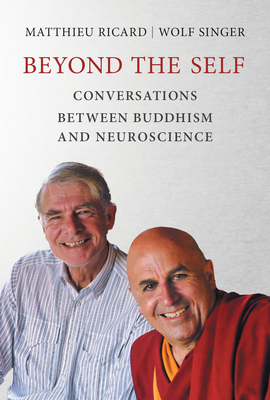
Beyond the Self: Conversations Between Buddhism and Neuroscience
| AUTHOR | Ricard, Matthieu; Singer, Wolf; Singer, Wolf et al. |
| PUBLISHER | MIT Press (11/13/2018) |
| PRODUCT TYPE | Paperback (Paperback) |
Description
A Buddhist monk and esteemed neuroscientist discuss their converging--and diverging--views on the mind and self, consciousness and the unconscious, free will and perception, and more. Buddhism shares with science the task of examining the mind empirically; it has pursued, for two millennia, direct investigation of the mind through penetrating introspection. Neuroscience, on the other hand, relies on third-person knowledge in the form of scientific observation. In this book, Matthieu Ricard, a Buddhist monk trained as a molecular biologist, and Wolf Singer, a distinguished neuroscientist--close friends, continuing an ongoing dialogue--offer their perspectives on the mind, the self, consciousness, the unconscious, free will, epistemology, meditation, and neuroplasticity. Ricard and Singer's wide-ranging conversation stages an enlightening and engaging encounter between Buddhism's wealth of experiential findings and neuroscience's abundance of experimental results. They discuss, among many other things, the difference between rumination and meditation (rumination is the scourge of meditation, but psychotherapy depends on it); the distinction between pure awareness and its contents; the Buddhist idea (or lack of one) of the unconscious and neuroscience's precise criteria for conscious and unconscious processes; and the commonalities between cognitive behavioral therapy and meditation. Their views diverge (Ricard asserts that the third-person approach will never encounter consciousness as a primary experience) and converge (Singer points out that the neuroscientific understanding of perception as reconstruction is very like the Buddhist all-discriminating wisdom) but both keep their vision trained on understanding fundamental aspects of human life.
Show More
Product Format
Product Details
ISBN-13:
9780262536141
ISBN-10:
0262536145
Binding:
Paperback or Softback (Trade Paperback (Us))
Content Language:
English
More Product Details
Page Count:
296
Carton Quantity:
20
Product Dimensions:
5.70 x 0.80 x 8.70 inches
Weight:
0.80 pound(s)
Feature Codes:
Index,
Price on Product
Country of Origin:
US
Subject Information
BISAC Categories
Science | Life Sciences - Neuroscience
Science | Mind & Body
Science | Buddhist
Grade Level:
College Freshman
and up
Dewey Decimal:
294.331
Library of Congress Control Number:
2017010026
Descriptions, Reviews, Etc.
publisher marketing
A Buddhist monk and esteemed neuroscientist discuss their converging--and diverging--views on the mind and self, consciousness and the unconscious, free will and perception, and more. Buddhism shares with science the task of examining the mind empirically; it has pursued, for two millennia, direct investigation of the mind through penetrating introspection. Neuroscience, on the other hand, relies on third-person knowledge in the form of scientific observation. In this book, Matthieu Ricard, a Buddhist monk trained as a molecular biologist, and Wolf Singer, a distinguished neuroscientist--close friends, continuing an ongoing dialogue--offer their perspectives on the mind, the self, consciousness, the unconscious, free will, epistemology, meditation, and neuroplasticity. Ricard and Singer's wide-ranging conversation stages an enlightening and engaging encounter between Buddhism's wealth of experiential findings and neuroscience's abundance of experimental results. They discuss, among many other things, the difference between rumination and meditation (rumination is the scourge of meditation, but psychotherapy depends on it); the distinction between pure awareness and its contents; the Buddhist idea (or lack of one) of the unconscious and neuroscience's precise criteria for conscious and unconscious processes; and the commonalities between cognitive behavioral therapy and meditation. Their views diverge (Ricard asserts that the third-person approach will never encounter consciousness as a primary experience) and converge (Singer points out that the neuroscientific understanding of perception as reconstruction is very like the Buddhist all-discriminating wisdom) but both keep their vision trained on understanding fundamental aspects of human life.
Show More
List Price $24.95
Your Price
$24.70