
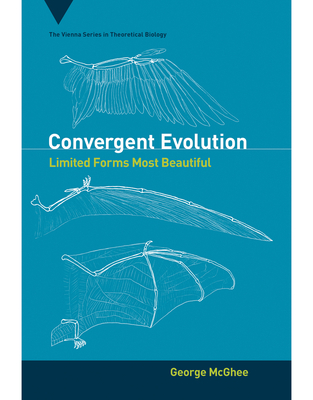
Convergent Evolution: Limited Forms Most Beautiful
| AUTHOR | McGhee, George R. |
| PUBLISHER | MIT Press (11/04/2011) |
| PRODUCT TYPE | Paperback (Paperback) |
Charles Darwin famously concluded On the Origin of Species with a vision of "endless forms most beautiful" continually evolving. More than 150 years later many evolutionary biologists see not endless forms but the same, or very similar, forms evolving repeatedly in many independent species lineages. A porpoise's fishlike fins, for example, are not inherited from fish ancestors but are independently derived convergent traits. In this book, George McGhee describes the ubiquity of the phenomenon of convergent evolution and connects it directly to the concept of evolutionary constraint--the idea that the number of evolutionary pathways available to life are not endless, but quite limited.
Convergent evolution occurs on all levels, from tiny organic molecules to entire ecosystems of species. McGhee demonstrates its ubiquity in animals, both herbivore and carnivore; in plants; in ecosystems; in molecules, including DNA, proteins, and enzymes; and even in minds, describing problem-solving behavior and group behavior as the products of convergence. For each species example, he provides an abbreviated list of the major nodes in its phylogenetic classification, allowing the reader to see the evolutionary relationship of a group of species that have independently evolved a similar trait by convergent evolution. McGhee analyzes the role of functional and developmental constraints in producing convergent evolution, and considers the scientific and philosophical implications of convergent evolution for the predictability of the evolutionary process.
Charles Darwin famously concluded On the Origin of Species with a vision of "endless forms most beautiful" continually evolving. More than 150 years later many evolutionary biologists see not endless forms but the same, or very similar, forms evolving repeatedly in many independent species lineages. A porpoise's fishlike fins, for example, are not inherited from fish ancestors but are independently derived convergent traits. In this book, George McGhee describes the ubiquity of the phenomenon of convergent evolution and connects it directly to the concept of evolutionary constraint--the idea that the number of evolutionary pathways available to life are not endless, but quite limited.
Convergent evolution occurs on all levels, from tiny organic molecules to entire ecosystems of species. McGhee demonstrates its ubiquity in animals, both herbivore and carnivore; in plants; in ecosystems; in molecules, including DNA, proteins, and enzymes; and even in minds, describing problem-solving behavior and group behavior as the products of convergence. For each species example, he provides an abbreviated list of the major nodes in its phylogenetic classification, allowing the reader to see the evolutionary relationship of a group of species that have independently evolved a similar trait by convergent evolution. McGhee analyzes the role of functional and developmental constraints in producing convergent evolution, and considers the scientific and philosophical implications of convergent evolution for the predictability of the evolutionary process.