
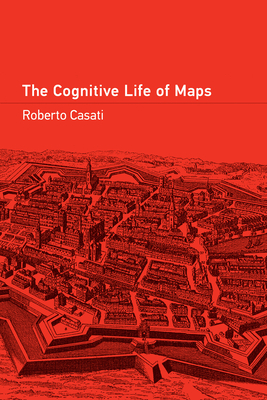
The Cognitive Life of Maps
| AUTHOR | Casati, Roberto |
| PUBLISHER | MIT Press (05/14/2024) |
| PRODUCT TYPE | Paperback (Paperback) |
Description
The "mapness of maps"--how maps live in interaction with their users, and what this tells us about what they are and how they work. In a sense, maps are temporarily alive for those who design, draw, and use them. They have, for the moment, a cognitive life. To grapple with what this means--to ask how maps can be alive, and what kind of life they have--is to explore the core question of what maps are. And this is what Roberto Casati does in The Cognitive Life of Maps, in the process assembling the conceptual tools for understanding why maps have the power they have, why they are so widely used, and how we use (and misuse) them. Drawing on insights from cognitive science and philosophy of mind, Casati considers the main claims around what maps are and how they work--their specific syntax, peculiar semantics, and pragmatics. He proposes a series of steps that can lead to a precise theory of maps, one that reveals what maps have in common with diagrams, pictures, and texts, and what makes them different. This minimal theory of maps helps us to see maps nested in many cognitive artifacts--clock faces, musical notation, writing, calendars, and numerical series, for instance. It also allows us to tackle the issue of the territorialization of maps--to show how maps can be used to draw specific spatial inferences about territories. From the mechanics of maps used for navigation to the differences and similarities between maps and pictures and models, Casati's ambitious work is a cognitive map in its own right, charting the way to a new understanding of what maps mean.
Show More
Product Format
Product Details
ISBN-13:
9780262547086
ISBN-10:
0262547082
Binding:
Paperback or Softback (Trade Paperback (Us))
Content Language:
English
More Product Details
Page Count:
256
Carton Quantity:
32
Product Dimensions:
5.98 x 0.71 x 8.90 inches
Weight:
0.92 pound(s)
Feature Codes:
Bibliography,
Index,
Price on Product,
Illustrated
Country of Origin:
US
Subject Information
BISAC Categories
Science | Cognitive Science
Science | Mind & Body
Science | Cartography
Dewey Decimal:
114
Library of Congress Control Number:
2023033657
Descriptions, Reviews, Etc.
publisher marketing
The "mapness of maps"--how maps live in interaction with their users, and what this tells us about what they are and how they work. In a sense, maps are temporarily alive for those who design, draw, and use them. They have, for the moment, a cognitive life. To grapple with what this means--to ask how maps can be alive, and what kind of life they have--is to explore the core question of what maps are. And this is what Roberto Casati does in The Cognitive Life of Maps, in the process assembling the conceptual tools for understanding why maps have the power they have, why they are so widely used, and how we use (and misuse) them. Drawing on insights from cognitive science and philosophy of mind, Casati considers the main claims around what maps are and how they work--their specific syntax, peculiar semantics, and pragmatics. He proposes a series of steps that can lead to a precise theory of maps, one that reveals what maps have in common with diagrams, pictures, and texts, and what makes them different. This minimal theory of maps helps us to see maps nested in many cognitive artifacts--clock faces, musical notation, writing, calendars, and numerical series, for instance. It also allows us to tackle the issue of the territorialization of maps--to show how maps can be used to draw specific spatial inferences about territories. From the mechanics of maps used for navigation to the differences and similarities between maps and pictures and models, Casati's ambitious work is a cognitive map in its own right, charting the way to a new understanding of what maps mean.
Show More
Your Price
$44.55