
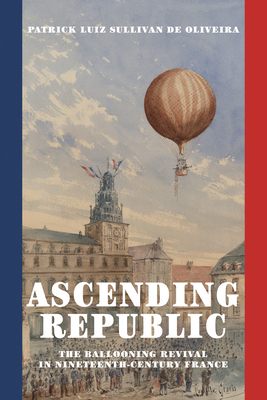
Ascending Republic: The Ballooning Revival in Nineteenth-Century France
| AUTHOR | Sullivan de Oliveira, Patrick Luiz; de Oliveira, Patrick Luiz Sulliva |
| PUBLISHER | MIT Press (06/10/2025) |
| PRODUCT TYPE | Paperback (Paperback) |
Description
Why and how the French made the balloon into one of the quintessential symbols of late nineteenth-century modernity, and how the balloon's reinvention shaped the airplane's assimilation in the early years of aviation. On August 27, 1783, a large crowd gathered in Paris to watch the first ascent of a hydrogen balloon. Despite the initial feverish enthusiasm, by the mid-nineteenth century the balloon remained relatively unchanged and was no longer seen as the harbinger of a new era. Yet that all changed in the last third of the century, when following the traumatic Franco-Prussian War defeat, the balloon reemerged to become the modern artifact that captured the attention of many. Through this process, the balloon became an important symbol of the fledgling Third Republic, and France established itself as the world leader in flight. In Ascending Republic, Patrick Luiz Sullivan De Oliveira tells for the first time the story of this surprising revival. Through extensive research in the press and archives in France, the United States, and Brazil, De Oliveira argues that French civil society cultivated popular enthusiasm for flight (what historians call "airmindedness") decades before the advent of the airplane. Champions of French ballooning made the case that if the British Royal Navy controlled the seas and the Imperial German Army dominated the continent, then France needed to take ownership of the skies. The French appropriated this newly imagined geopolitical space through a variety of practices, from republican savants who studied the atmosphere at high altitudes to aristocrats who organized transcontinental long-distance competitions. All of this made Paris into the global capital of a thriving aeronautical culture that incorporated seemingly contradictory visions of sacrificial patriotism, aristocratic modernity, colonial anxiety, and technological cosmopolitanism.
Show More
Product Format
Product Details
ISBN-13:
9780262549806
ISBN-10:
0262549808
Binding:
Paperback or Softback (Trade Paperback (Us))
Content Language:
English
More Product Details
Page Count:
400
Carton Quantity:
22
Feature Codes:
Bibliography,
Index
Country of Origin:
US
Subject Information
BISAC Categories
Technology & Engineering | Aeronautics & Astronautics
Technology & Engineering | History
Technology & Engineering | Europe - France
Dewey Decimal:
797.510
Library of Congress Control Number:
2024030349
Descriptions, Reviews, Etc.
publisher marketing
Why and how the French made the balloon into one of the quintessential symbols of late nineteenth-century modernity, and how the balloon's reinvention shaped the airplane's assimilation in the early years of aviation. On August 27, 1783, a large crowd gathered in Paris to watch the first ascent of a hydrogen balloon. Despite the initial feverish enthusiasm, by the mid-nineteenth century the balloon remained relatively unchanged and was no longer seen as the harbinger of a new era. Yet that all changed in the last third of the century, when following the traumatic Franco-Prussian War defeat, the balloon reemerged to become the modern artifact that captured the attention of many. Through this process, the balloon became an important symbol of the fledgling Third Republic, and France established itself as the world leader in flight. In Ascending Republic, Patrick Luiz Sullivan De Oliveira tells for the first time the story of this surprising revival. Through extensive research in the press and archives in France, the United States, and Brazil, De Oliveira argues that French civil society cultivated popular enthusiasm for flight (what historians call "airmindedness") decades before the advent of the airplane. Champions of French ballooning made the case that if the British Royal Navy controlled the seas and the Imperial German Army dominated the continent, then France needed to take ownership of the skies. The French appropriated this newly imagined geopolitical space through a variety of practices, from republican savants who studied the atmosphere at high altitudes to aristocrats who organized transcontinental long-distance competitions. All of this made Paris into the global capital of a thriving aeronautical culture that incorporated seemingly contradictory visions of sacrificial patriotism, aristocratic modernity, colonial anxiety, and technological cosmopolitanism.
Show More
Your Price
$64.35