
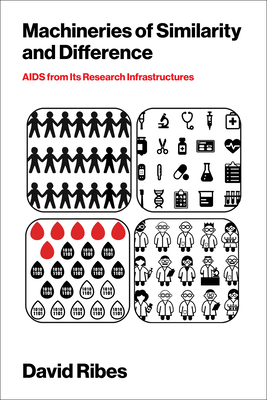
Machineries of Similarity and Difference: AIDS from Its Research Infrastructures (Not yet published)
| AUTHOR | Ribes, David |
| PUBLISHER | MIT Press (04/21/2026) |
| PRODUCT TYPE | Paperback (Paperback) |
Description
An examination of three research infrastructures over three decades as they sought to support studies of HIV/AIDS across dramatic changes to the disease, the science, and its politics. In Machineries of Similarity and Difference, David Ribes theorizes interoperability, or how to make different things work together. For the last 30 years, standardization has been the dominant social scientific motif for understanding coordination and collaboration across time and space. But across those years much has changed, in part through computational and other technical advances, in part through a new orientation to the value of similarity and difference. Interoperation is an ascendent social form. To examine the production of equivalency, the author offers a book-length extended case study of three keystone research infrastructures that have been supporting investigations of AIDS for over 35 years--nearly since the beginning of the US epidemic, even before we knew of HIV. The book is thus an examination of historical epistemology and ontology with respect to research infrastructure, attending to the technical conflicts and social politics that play out within and across scientific arenas and social worlds.
Show More
Product Format
Product Details
ISBN-13:
9780262553599
ISBN-10:
0262553597
Binding:
Paperback or Softback (Trade Paperback (Us))
Content Language:
English
More Product Details
Page Count:
326
Carton Quantity:
24
Weight:
0.81 pound(s)
Country of Origin:
US
Subject Information
BISAC Categories
Science | Research & Methodology
Science | AIDS & HIV
Science | History
Descriptions, Reviews, Etc.
publisher marketing
An examination of three research infrastructures over three decades as they sought to support studies of HIV/AIDS across dramatic changes to the disease, the science, and its politics. In Machineries of Similarity and Difference, David Ribes theorizes interoperability, or how to make different things work together. For the last 30 years, standardization has been the dominant social scientific motif for understanding coordination and collaboration across time and space. But across those years much has changed, in part through computational and other technical advances, in part through a new orientation to the value of similarity and difference. Interoperation is an ascendent social form. To examine the production of equivalency, the author offers a book-length extended case study of three keystone research infrastructures that have been supporting investigations of AIDS for over 35 years--nearly since the beginning of the US epidemic, even before we knew of HIV. The book is thus an examination of historical epistemology and ontology with respect to research infrastructure, attending to the technical conflicts and social politics that play out within and across scientific arenas and social worlds.
Show More
Your Price
$69.30