
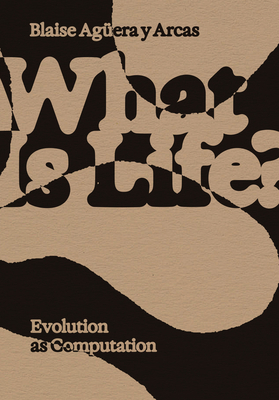
What Is Life?: Evolution as Computation
| AUTHOR | Aguera Y. Arcas, Blaise |
| PUBLISHER | MIT Press (03/11/2025) |
| PRODUCT TYPE | Paperback (Paperback) |
Description
What life is, and how its essence can be understood as computation that grows more complex over time in symbiotic relationships. In 1944, quantum mechanics pioneer Erwin Schrödinger wrote a slim but influential volume, What Is Life?, posing the primary question that rendered biology so mysterious to a physicist. How can life and all its attendant complexities come to exist in a random universe, governed by simple laws, whose disorder only increases over time? This small book, richly illustrated and written for a general audience, offers a deep and surprising answer, drawing on decades of theory and existing literature as well as recent experiments in artificial life. Beginning with ideas developed by Alan Turing and John von Neumann in the mid-twentieth century, Agüera y Arcas shows how self-reproduction, hence life, is inherently computational. Life evolves spontaneously in environments capable of supporting computation, like our own universe, and grows more complex over time as it enters symbiotic relationships with itself. What Is Life? is also the first part of Agüera y Arcas's larger book What Is Intelligence?, which further develops a computational and symbiotic perspective on intelligence, from simple organisms to brains and societies to AI.
Show More
Product Format
Product Details
ISBN-13:
9780262554091
ISBN-10:
0262554097
Binding:
Paperback or Softback (Trade Paperback (Us))
Content Language:
English
More Product Details
Page Count:
170
Carton Quantity:
48
Product Dimensions:
4.20 x 0.70 x 5.80 inches
Weight:
0.25 pound(s)
Feature Codes:
Price on Product
Country of Origin:
BE
Subject Information
BISAC Categories
Science | Life Sciences - Evolution
Science | Natural History
Science | Artificial Intelligence - General
Descriptions, Reviews, Etc.
publisher marketing
What life is, and how its essence can be understood as computation that grows more complex over time in symbiotic relationships. In 1944, quantum mechanics pioneer Erwin Schrödinger wrote a slim but influential volume, What Is Life?, posing the primary question that rendered biology so mysterious to a physicist. How can life and all its attendant complexities come to exist in a random universe, governed by simple laws, whose disorder only increases over time? This small book, richly illustrated and written for a general audience, offers a deep and surprising answer, drawing on decades of theory and existing literature as well as recent experiments in artificial life. Beginning with ideas developed by Alan Turing and John von Neumann in the mid-twentieth century, Agüera y Arcas shows how self-reproduction, hence life, is inherently computational. Life evolves spontaneously in environments capable of supporting computation, like our own universe, and grows more complex over time as it enters symbiotic relationships with itself. What Is Life? is also the first part of Agüera y Arcas's larger book What Is Intelligence?, which further develops a computational and symbiotic perspective on intelligence, from simple organisms to brains and societies to AI.
Show More
List Price $14.95
Your Price
$14.80