
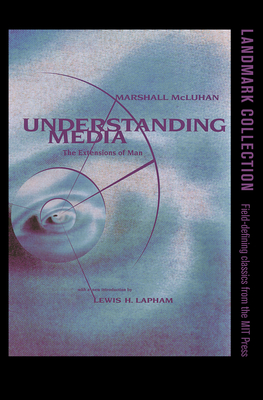
Understanding Media: The Extensions of Man
| AUTHOR | McLuhan, Marshall; Lapham, Lewis H.; McLuhan, Marshall |
| PUBLISHER | MIT Press (10/24/1994) |
| PRODUCT TYPE | Paperback (Paperback) |
Description
The groundbreaking, seminal work that redefined the way we think about communication--and the then-emerging phenomenon of mass media.
Marshall McLuhan's classic work Understanding Media was called "a timeless analysis of how language, speech, and technology shape human behavior in the era of mass communication" by the Wall Street Journal when it was first published in 1964. The book famously anticipated the impact of electronic media and the internet on culture and society, and challenged our assumptions about how and what we communicate. It also coined the well-known phrases "the media is the message" and "the global village," which described, respectively, the hierarchy of media and content and the shrinking of our world due to electronic media. In this edition's introduction, esteemed editor and writer Lewis Lapham reevaluated McLuhan's work in the light of technological as well as political and social changes in the latter half of the twentieth century, showing why McLuhan's theories enjoyed the critical influence that they did and how he became one of the prophetic voices of our time. In an age of constant connectedness, it is all too easy to forget we did not always live our lives immersed in social media and push notifications. This book offers an invaluable glimpse at just how we got here.
Marshall McLuhan's classic work Understanding Media was called "a timeless analysis of how language, speech, and technology shape human behavior in the era of mass communication" by the Wall Street Journal when it was first published in 1964. The book famously anticipated the impact of electronic media and the internet on culture and society, and challenged our assumptions about how and what we communicate. It also coined the well-known phrases "the media is the message" and "the global village," which described, respectively, the hierarchy of media and content and the shrinking of our world due to electronic media. In this edition's introduction, esteemed editor and writer Lewis Lapham reevaluated McLuhan's work in the light of technological as well as political and social changes in the latter half of the twentieth century, showing why McLuhan's theories enjoyed the critical influence that they did and how he became one of the prophetic voices of our time. In an age of constant connectedness, it is all too easy to forget we did not always live our lives immersed in social media and push notifications. This book offers an invaluable glimpse at just how we got here.
Show More
Product Format
Product Details
ISBN-13:
9780262631594
ISBN-10:
0262631598
Binding:
Paperback or Softback (Trade Paperback (Us))
Content Language:
English
More Product Details
Page Count:
400
Carton Quantity:
24
Product Dimensions:
5.94 x 0.97 x 8.90 inches
Weight:
1.14 pound(s)
Feature Codes:
Price on Product,
Ikids
Country of Origin:
US
Subject Information
BISAC Categories
Social Science | Sociology - General
Social Science | Media Studies
Grade Level:
College Freshman
and up
Dewey Decimal:
302.23
Library of Congress Control Number:
94027722
Descriptions, Reviews, Etc.
publisher marketing
The groundbreaking, seminal work that redefined the way we think about communication--and the then-emerging phenomenon of mass media.
Marshall McLuhan's classic work Understanding Media was called "a timeless analysis of how language, speech, and technology shape human behavior in the era of mass communication" by the Wall Street Journal when it was first published in 1964. The book famously anticipated the impact of electronic media and the internet on culture and society, and challenged our assumptions about how and what we communicate. It also coined the well-known phrases "the media is the message" and "the global village," which described, respectively, the hierarchy of media and content and the shrinking of our world due to electronic media. In this edition's introduction, esteemed editor and writer Lewis Lapham reevaluated McLuhan's work in the light of technological as well as political and social changes in the latter half of the twentieth century, showing why McLuhan's theories enjoyed the critical influence that they did and how he became one of the prophetic voices of our time. In an age of constant connectedness, it is all too easy to forget we did not always live our lives immersed in social media and push notifications. This book offers an invaluable glimpse at just how we got here.
Marshall McLuhan's classic work Understanding Media was called "a timeless analysis of how language, speech, and technology shape human behavior in the era of mass communication" by the Wall Street Journal when it was first published in 1964. The book famously anticipated the impact of electronic media and the internet on culture and society, and challenged our assumptions about how and what we communicate. It also coined the well-known phrases "the media is the message" and "the global village," which described, respectively, the hierarchy of media and content and the shrinking of our world due to electronic media. In this edition's introduction, esteemed editor and writer Lewis Lapham reevaluated McLuhan's work in the light of technological as well as political and social changes in the latter half of the twentieth century, showing why McLuhan's theories enjoyed the critical influence that they did and how he became one of the prophetic voices of our time. In an age of constant connectedness, it is all too easy to forget we did not always live our lives immersed in social media and push notifications. This book offers an invaluable glimpse at just how we got here.
Show More
Your Price
$34.65