
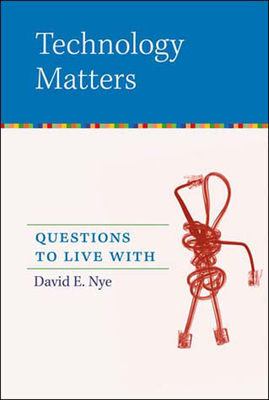
Technology Matters: Questions to Live With
| AUTHOR | Nye, David E.; Nye, David E. |
| PUBLISHER | MIT Press (10/01/2007) |
| PRODUCT TYPE | Paperback (Paperback) |
Technology matters, writes David Nye, because it is inseparable from being human. We have used tools for more than 100,000 years, and their central purpose has not always been to provide necessities. People excel at using old tools to solve new problems and at inventing new tools for more elegant solutions to old tasks. Perhaps this is because we are intimate with devices and machines from an early age--as children, we play with technological toys: trucks, cars, stoves, telephones, model railroads, Playstations. Through these machines we imagine ourselves into a creative relationship with the world. As adults, we retain this technological playfulness with gadgets and appliances--Blackberries, cell phones, GPS navigation systems in our cars.
We use technology to shape our world, yet we think little about the choices we are making. In Technology Matters, Nye tackles ten central questions about our relationship to technology, integrating a half-century of ideas about technology into ten cogent and concise chapters, with wide-ranging historical examples from many societies. He asks: Can we define technology? Does technology shape us, or do we shape it? Is technology inevitable or unpredictable? (Why do experts often fail to get it right?)? How do historians understand it? Are we using modern technology to create cultural uniformity, or diversity? To create abundance, or an ecological crisis? To destroy jobs or create new opportunities? Should "the market" choose our technologies? Do advanced technologies make us more secure, or escalate dangers? Does ubiquitous technology expand our mental horizons, or encapsulate us in artifice?
These large questions may have no final answers yet, but we need to wrestle with them--to live them, so that we may, as Rilke puts it, "live along some distant day into the answers."
Technology matters, writes David Nye, because it is inseparable from being human. We have used tools for more than 100,000 years, and their central purpose has not always been to provide necessities. People excel at using old tools to solve new problems and at inventing new tools for more elegant solutions to old tasks. Perhaps this is because we are intimate with devices and machines from an early age--as children, we play with technological toys: trucks, cars, stoves, telephones, model railroads, Playstations. Through these machines we imagine ourselves into a creative relationship with the world. As adults, we retain this technological playfulness with gadgets and appliances--Blackberries, cell phones, GPS navigation systems in our cars.
We use technology to shape our world, yet we think little about the choices we are making. In Technology Matters, Nye tackles ten central questions about our relationship to technology, integrating a half-century of ideas about technology into ten cogent and concise chapters, with wide-ranging historical examples from many societies. He asks: Can we define technology? Does technology shape us, or do we shape it? Is technology inevitable or unpredictable? (Why do experts often fail to get it right?)? How do historians understand it? Are we using modern technology to create cultural uniformity, or diversity? To create abundance, or an ecological crisis? To destroy jobs or create new opportunities? Should "the market" choose our technologies? Do advanced technologies make us more secure, or escalate dangers? Does ubiquitous technology expand our mental horizons, or encapsulate us in artifice?
These large questions may have no final answers yet, but we need to wrestle with them--to live them, so that we may, as Rilke puts it, "live along some distant day into the answers."