
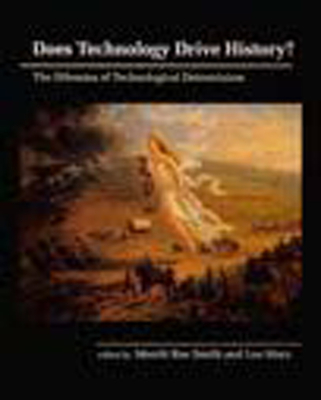
Does Technology Drive History?: The Dilemma of Technological Determinism
| PUBLISHER | MIT Press (06/02/1994) |
| PRODUCT TYPE | Paperback (Paperback) |
These thirteen essays explore a crucial historical question that has been notoriously hard to pin down: To what extent, and by what means, does a society's technology determine its political, social, economic, and cultural forms? Karl Marx launched the modern debate on determinism with his provocative remark that "the hand-mill gives you society with the feudal lord; the steam-mill, society with the industrial capitalist," and a classic article by Robert Heilbroner (reprinted here) renewed the debate within the context of the history of technology. This book clarifies the debate and carries it forward.Marx's position has become embedded in our culture, in the form of constant reminders as to how our fast-changing technologies will alter our lives. Yet historians who have looked closely at where technologies really come from generally support the proposition that technologies are not autonomous but are social products, susceptible to democratic controls. The issue is crucial for democratic theory. These essays tackle it head-on, offering a deep look at all the shadings of determinism and assessing determinist models in a wide variety of historical contexts.
Contributors
Bruce Bimber, Richard W. Bulliet, Robert L. Heilbroner, Thomas P. Hughes, Leo Marx, Thomas J. Misa, Peter C. Perdue, Philip Scranton, Merritt Roe Smith, Michael L. Smith, John M. Staudenmaier, Rosalind Williams
These thirteen essays explore a crucial historical question that has been notoriously hard to pin down: To what extent, and by what means, does a society's technology determine its political, social, economic, and cultural forms? Karl Marx launched the modern debate on determinism with his provocative remark that "the hand-mill gives you society with the feudal lord; the steam-mill, society with the industrial capitalist," and a classic article by Robert Heilbroner (reprinted here) renewed the debate within the context of the history of technology. This book clarifies the debate and carries it forward.Marx's position has become embedded in our culture, in the form of constant reminders as to how our fast-changing technologies will alter our lives. Yet historians who have looked closely at where technologies really come from generally support the proposition that technologies are not autonomous but are social products, susceptible to democratic controls. The issue is crucial for democratic theory. These essays tackle it head-on, offering a deep look at all the shadings of determinism and assessing determinist models in a wide variety of historical contexts.
Contributors
Bruce Bimber, Richard W. Bulliet, Robert L. Heilbroner, Thomas P. Hughes, Leo Marx, Thomas J. Misa, Peter C. Perdue, Philip Scranton, Merritt Roe Smith, Michael L. Smith, John M. Staudenmaier, Rosalind Williams