
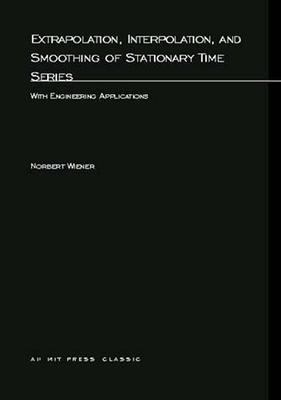
Extrapolation, Interpolation, and Smoothing of Stationary Time Series: With Engineering Applications
| AUTHOR | Wiener, Norbert; Wiener, Norbert |
| PUBLISHER | MIT Press (03/15/1964) |
| PRODUCT TYPE | Paperback (Paperback) |
Some predict that Norbert Wiener will be remembered for his Extrapolation long after Cybernetics is forgotten. Indeed, few computer science students would know today what cybernetics is all about, while every communication student knows what Wiener's filter is. The original work was circulated as a classified memorandum in 1942, because it was connected with sensitive wartime efforts to improve radar communication. This book became the basis for modern communication theory, by a scientist considered one of the founders of the field of artifical intelligence. Combining ideas from statistics and time-series analysis, Wiener used Gauss's method of shaping the characteristic of a detector to allow for the maximal recognition of signals in the presence of noise. This method came to be known as the "Wiener filter."
Some predict that Norbert Wiener will be remembered for his Extrapolation long after Cybernetics is forgotten. Indeed, few computer science students would know today what cybernetics is all about, while every communication student knows what Wiener's filter is. The original work was circulated as a classified memorandum in 1942, because it was connected with sensitive wartime efforts to improve radar communication. This book became the basis for modern communication theory, by a scientist considered one of the founders of the field of artifical intelligence. Combining ideas from statistics and time-series analysis, Wiener used Gauss's method of shaping the characteristic of a detector to allow for the maximal recognition of signals in the presence of noise. This method came to be known as the "Wiener filter."