
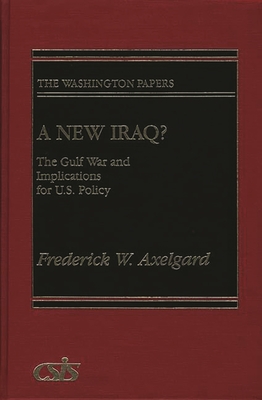
ISBN 9780275930134 is out of print and is currently unavailable, alternate formats (if applicable) are shown below.
Available options are listed below:
Available options are listed below:
A New Iraq: The Gulf War and the Implications for U.S. Policy (Out of print)
| AUTHOR | Axelgard, Frederick; Axelgard, Frederick W. |
| PUBLISHER | Praeger (03/25/1988) |
| PRODUCT TYPE | Hardcover (Hardcover) |
Description
The volume analyzes the political and economic effects of the Iran-Iraq war upon Iraq, focusing on whether the war has united Iraqi society in a way that has not happened since the country was established in 1920. It opens with an examination of Iraqi political development and U.S. policy toward Iraq. Following is a discussion of the various means of political consolidation of Iraq. The next chapter investigates the growth of Iraqi foreign policy in relation to both the Arab state and the superpowers. The book also predicts the country's ability to hold together under current military and economic pressure. Finally, the author discusses the future of U.S. policy toward Iraq. Policy makers, policy analysts, and scholars in Middle East studies will find this volume to be timely, well reasoned, and informative.
Show More
Product Format
Product Details
ISBN-13:
9780275930134
ISBN-10:
0275930130
Binding:
Hardback or Cased Book (Sewn)
Content Language:
English
More Product Details
Page Count:
139
Carton Quantity:
22
Product Dimensions:
6.14 x 0.38 x 9.21 inches
Weight:
0.84 pound(s)
Feature Codes:
Dust Cover
Country of Origin:
US
Subject Information
BISAC Categories
Political Science | Comparative Politics
Political Science | Cultural & Ethnic Studies - General
Political Science | Military - General
Accelerated Reader:
Reading Level:
0
Point Value:
0
Guided Reading Level:
Not Applicable
Dewey Decimal:
955.054
Library of Congress Control Number:
DS79
Descriptions, Reviews, Etc.
publisher marketing
The volume analyzes the political and economic effects of the Iran-Iraq war upon Iraq, focusing on whether the war has united Iraqi society in a way that has not happened since the country was established in 1920. It opens with an examination of Iraqi political development and U.S. policy toward Iraq. Following is a discussion of the various means of political consolidation of Iraq. The next chapter investigates the growth of Iraqi foreign policy in relation to both the Arab state and the superpowers. The book also predicts the country's ability to hold together under current military and economic pressure. Finally, the author discusses the future of U.S. policy toward Iraq. Policy makers, policy analysts, and scholars in Middle East studies will find this volume to be timely, well reasoned, and informative.
Show More
Your Price
$74.25