
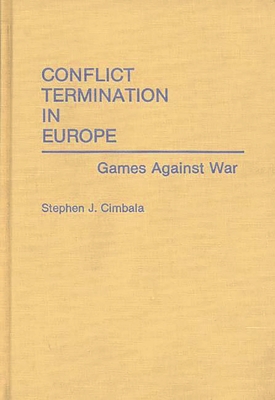
Conflict Termination in Europe: Games Against War
| AUTHOR | Cimbala, Stephen J. |
| PUBLISHER | Praeger (10/30/1990) |
| PRODUCT TYPE | Hardcover (Hardcover) |
An important contribution to the international relations and military studies literature, this study considers the problem of conflict termination in Europe--an area of immense strategic importance to both the United States and the Soviet Union. The author argues that a well-thought-out policy for conflict termination is lacking within the NATO alliance, which currently relies almost exclusively on policies that emphasize the prevention of war. This lack of a conflict termination strategy, Cimbala asserts, leaves nations open to the danger of a quickly escalating nuclear conflict, should prevention policies fail and a war in Europe actually occur. In developing his arguments, Cimbala considers the relationship between war and politics as perceived by Soviet and Western planners; compares the superpowers' likely views on the process of escalation; and assesses the command, control, and communications perspectives implicit in Soviet and American writings and deployments and their implications for war termination.
Cimbala begins with an overview of the problems and choices involved in ending war in Europe under contemporary conditions. Subsequent chapters examine such topics as the philosophical and practical issues related to the problem of preemption; the problem of military stability and its specific applications to modern Europe; and Western and Soviet approaches to the escalation and limitation of war. Soviet perspectives on command and control as well as the Soviet view of war termination receive extended treatment in two chapters. Finally, Cimbala contrasts the orthodox view of mutual assured destruction with the strategic revisionism of defense dominance or mutual assured survival. He concludes that policymakers and military planners must recognize that nuclear weapons will almost certainly be a part of any war in Europe and that termination must focus on limiting the use of these weapons before the pressures of in the field escalation tendencies begin to work against the early conclusion of a conflict. Students and scholars of military policy will find Cimbala's work enlightening and provocative reading.An important contribution to the international relations and military studies literature, this study considers the problem of conflict termination in Europe--an area of immense strategic importance to both the United States and the Soviet Union. The author argues that a well-thought-out policy for conflict termination is lacking within the NATO alliance, which currently relies almost exclusively on policies that emphasize the prevention of war. This lack of a conflict termination strategy, Cimbala asserts, leaves nations open to the danger of a quickly escalating nuclear conflict, should prevention policies fail and a war in Europe actually occur. In developing his arguments, Cimbala considers the relationship between war and politics as perceived by Soviet and Western planners; compares the superpowers' likely views on the process of escalation; and assesses the command, control, and communications perspectives implicit in Soviet and American writings and deployments and their implications for war termination.
Cimbala begins with an overview of the problems and choices involved in ending war in Europe under contemporary conditions. Subsequent chapters examine such topics as the philosophical and practical issues related to the problem of preemption; the problem of military stability and its specific applications to modern Europe; and Western and Soviet approaches to the escalation and limitation of war. Soviet perspectives on command and control as well as the Soviet view of war termination receive extended treatment in two chapters. Finally, Cimbala contrasts the orthodox view of mutual assured destruction with the strategic revisionism of defense dominance or mutual assured survival. He concludes that policymakers and military planners must recognize that nuclear weapons will almost certainly be a part of any war in Europe and that termination must focus on limiting the use of these weapons before the pressures of in the field escalation tendencies begin to work against the early conclusion of a conflict. Students and scholars of military policy will find Cimbala's work enlightening and provocative reading.