
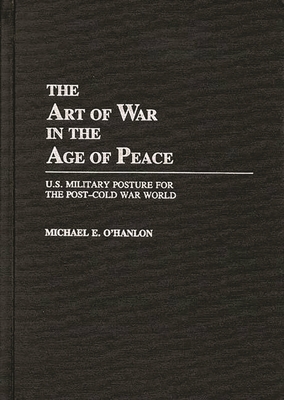
The Art of War in the Age of Peace: U.S. Military Posture for the Post-Cold War World
| AUTHOR | O'Hanlon, Michael E. |
| PUBLISHER | Praeger (08/24/1992) |
| PRODUCT TYPE | Hardcover (Hardcover) |
This study begins with a set of strategic assumptions--most notably that the risks of U.S.-Russian war are and will remain extremely low and that the U.S. military remains a stabilizing influence in many geographic theaters. O'Hanlon then shows that the United States' interests in the Third World, while nowhere truly vital, are sufficiently important to justify a measured degree of global military presence and engagement. Historical, political, and military analysis suggests that these interests can be protected efficiently and effectively with a U.S. military reduced in size by roughly 40 to 50 percent in most types of major combat forces, and by 95 percent in nuclear forces. In the realm of conventional forces, these cuts would be about twice as deep as those planned by Secretary of Defense Richard Cheney; in the nuclear realm they would be much deeper than those approved by the Bush administration. By contrast, analysis suggests that U.S. capabilities should be largely held constant--or in some cases even expanded--in logistics, intelligence and communications, R&D, and special forces.
The resulting force posture would cost about $200 billion in 1991 dollars through the early years of the next century, and perhaps $230 billion annually thereafter. O'Hanlon's is one of the first in-depth studies of how the U.S. military might be reconfigured for the post-Cold War world. This study will prove useful for defense policy makers at the specialized levels and for students of the guns vs. butter policy issues and debates.This study begins with a set of strategic assumptions--most notably that the risks of U.S.-Russian war are and will remain extremely low and that the U.S. military remains a stabilizing influence in many geographic theaters. O'Hanlon then shows that the United States' interests in the Third World, while nowhere truly vital, are sufficiently important to justify a measured degree of global military presence and engagement. Historical, political, and military analysis suggests that these interests can be protected efficiently and effectively with a U.S. military reduced in size by roughly 40 to 50 percent in most types of major combat forces, and by 95 percent in nuclear forces. In the realm of conventional forces, these cuts would be about twice as deep as those planned by Secretary of Defense Richard Cheney; in the nuclear realm they would be much deeper than those approved by the Bush administration. By contrast, analysis suggests that U.S. capabilities should be largely held constant--or in some cases even expanded--in logistics, intelligence and communications, R&D, and special forces.
The resulting force posture would cost about $200 billion in 1991 dollars through the early years of the next century, and perhaps $230 billion annually thereafter. O'Hanlon's is one of the first in-depth studies of how the U.S. military might be reconfigured for the post-Cold War world. This study will prove useful for defense policy makers at the specialized levels and for students of the guns vs. butter policy issues and debates.