
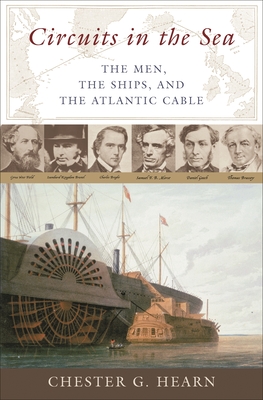
Circuits in the Sea: The Men, the Ships, and the Atlantic Cable
| AUTHOR | Hearn, Chester G.; Hearn, Chester |
| PUBLISHER | Praeger (08/30/2004) |
| PRODUCT TYPE | Hardcover (Hardcover) |
This book tells the story of the scientific talent and technological prowess of two nations that joined forces to connect themselves with a communications cable that would change the world. In 1855 an American visionary named Cyrus West Field, who knew nothing about telegraphy, sought to establish a monopoly on telegraphic revenues between North America and Europe. Field and the wealthy New Yorkers who formed the first Atlantic cable-laying company never suspected that spanning the vast and stormy Atlantic would require 11 years of frustration and horrific financial sacrifice. The enterprise would eventually engage some of the most brilliant minds in England, Scotland, and the United States, attracting men of science, men of wealth, and men of curiosity. Message time would be cut from more than four weeks to about two minutes. Such a feat would not have been possible without the massive ship the Great Eastern, designed by Isambard Kingdom Brunel, Britain's foremost engineer, or the financial backing of Thomas Brassey, the era's greatest builder of railroads.
Despite four failed attempts and the enmity that developed between the Union and Great Britain during America's Civil War, Field never stopped urging his British friends to perfect a cable that could function in water as deep as two and a half miles. Without the unified effort of this small cadre of determined engineers, decades may have passed before submarine cables became reliable. This is the story of these men, their ships, and the technology that made it all possible. Behind the scenes were tough and worthy competitors who tried to beat them to the punch, adding a sense of urgency to their monumental task. Some called the Atlantic cable the greatest feat of the 19th century--with good reason. It perfected transoceanic communications and connected the world with circuits in the sea.This book tells the story of the scientific talent and technological prowess of two nations that joined forces to connect themselves with a communications cable that would change the world. In 1855 an American visionary named Cyrus West Field, who knew nothing about telegraphy, sought to establish a monopoly on telegraphic revenues between North America and Europe. Field and the wealthy New Yorkers who formed the first Atlantic cable-laying company never suspected that spanning the vast and stormy Atlantic would require 11 years of frustration and horrific financial sacrifice. The enterprise would eventually engage some of the most brilliant minds in England, Scotland, and the United States, attracting men of science, men of wealth, and men of curiosity. Message time would be cut from more than four weeks to about two minutes. Such a feat would not have been possible without the massive ship the Great Eastern, designed by Isambard Kingdom Brunel, Britain's foremost engineer, or the financial backing of Thomas Brassey, the era's greatest builder of railroads.
Despite four failed attempts and the enmity that developed between the Union and Great Britain during America's Civil War, Field never stopped urging his British friends to perfect a cable that could function in water as deep as two and a half miles. Without the unified effort of this small cadre of determined engineers, decades may have passed before submarine cables became reliable. This is the story of these men, their ships, and the technology that made it all possible. Behind the scenes were tough and worthy competitors who tried to beat them to the punch, adding a sense of urgency to their monumental task. Some called the Atlantic cable the greatest feat of the 19th century--with good reason. It perfected transoceanic communications and connected the world with circuits in the sea.