
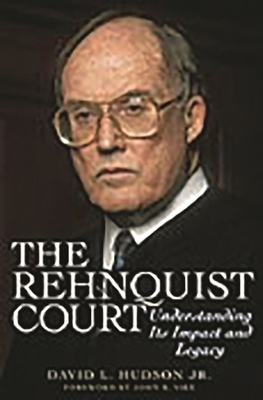
The Rehnquist Court: Understanding Its Impact and Legacy
| AUTHOR | Jr, David L. Hudson; Hudson, David; Hudson, David L. et al. |
| PUBLISHER | Praeger (12/30/2006) |
| PRODUCT TYPE | Hardcover (Hardcover) |
Description
For nearly 20 years, William Hubbs Rehnquist served as the 16th Chief Justice of the United States Supreme Court. During these two decades, the Court issued major decisions involving federalism, abortion, affirmative action, civil rights, privacy, and the 2000 presidential election. Throughout his tenure, Justice Rehnquist was conventionally perceived as a conservative, partly for the anti-civil rights memos he had written earlier in his career. He became a lightning rod for controversy during his confirmation hearings in 1972 for Associate Justice and again in 1986 when he became Chief Justice. Surprisingly, however, Hudson's balanced, nonpartisan examination of the Rehnquist Court and its personalities shows that Rehnquist's conservatism is quite mild compared to that of the ideological purity of Justices Clarence Thomas and Antonin Scalia, and that Rehnquist did an admirable job of playing moderator as Chief Justice, exhibiting sensitivity toward his colleagues.
Show More
Product Format
Product Details
ISBN-13:
9780275989712
ISBN-10:
0275989712
Binding:
Hardback or Cased Book (Sewn)
Content Language:
English
More Product Details
Page Count:
208
Carton Quantity:
34
Product Dimensions:
6.38 x 0.82 x 9.50 inches
Weight:
1.05 pound(s)
Feature Codes:
Bibliography,
Index,
Dust Cover,
Table of Contents,
Illustrated
Country of Origin:
US
Subject Information
BISAC Categories
Law | Courts - General
Law | Constitutional
Dewey Decimal:
347.732
Library of Congress Control Number:
2006028064
Descriptions, Reviews, Etc.
publisher marketing
For nearly 20 years, William Hubbs Rehnquist served as the 16th Chief Justice of the United States Supreme Court. During these two decades, the Court issued major decisions involving federalism, abortion, affirmative action, civil rights, privacy, and the 2000 presidential election. Throughout his tenure, Justice Rehnquist was conventionally perceived as a conservative, partly for the anti-civil rights memos he had written earlier in his career. He became a lightning rod for controversy during his confirmation hearings in 1972 for Associate Justice and again in 1986 when he became Chief Justice. Surprisingly, however, Hudson's balanced, nonpartisan examination of the Rehnquist Court and its personalities shows that Rehnquist's conservatism is quite mild compared to that of the ideological purity of Justices Clarence Thomas and Antonin Scalia, and that Rehnquist did an admirable job of playing moderator as Chief Justice, exhibiting sensitivity toward his colleagues.
Show More
Your Price
$99.00