
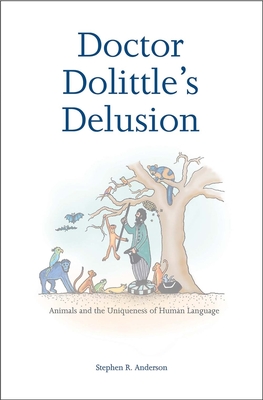
Doctor Dolittle's Delusion: Animals and the Uniqueness of Human Language
| AUTHOR | Anderson, Stephen R. |
| PUBLISHER | Yale University Press (05/01/2006) |
| PRODUCT TYPE | Paperback (Paperback) |
Description
Dr. Dolittle--and many students of animal communication--are wrong: animals cannot use language. This fascinating book explains why. Can animals be taught a human language and use it to communicate? Or is human language unique to human beings, just as many complex behaviors of other species are uniquely theirs? This engrossing book explores communication and cognition in animals and humans from a linguistic point of view and asserts that animals are not capable of acquiring or using human language.
Stephen R. Anderson explains what is meant by communication, the difference between communication and language, and the essential characteristics of language. Next he examines a variety of animal communication systems, including bee dances, frog vocalizations, bird songs, and alarm calls and other vocal, gestural, and olfactory communication among primates. Anderson then compares these to human language, including signed languages used by the deaf. Arguing that attempts to teach human languages or their equivalents to the great apes have not succeeded in demonstrating linguistic abilities in nonhuman species, he concludes that animal communication systems--intriguing and varied though they may be--do not include all the essential properties of human language. Animals can communicate, but they can't talk.
Stephen R. Anderson explains what is meant by communication, the difference between communication and language, and the essential characteristics of language. Next he examines a variety of animal communication systems, including bee dances, frog vocalizations, bird songs, and alarm calls and other vocal, gestural, and olfactory communication among primates. Anderson then compares these to human language, including signed languages used by the deaf. Arguing that attempts to teach human languages or their equivalents to the great apes have not succeeded in demonstrating linguistic abilities in nonhuman species, he concludes that animal communication systems--intriguing and varied though they may be--do not include all the essential properties of human language. Animals can communicate, but they can't talk.
Show More
Product Format
Product Details
ISBN-13:
9780300115253
ISBN-10:
0300115253
Binding:
Paperback or Softback (Trade Paperback (Us))
Content Language:
English
More Product Details
Page Count:
368
Carton Quantity:
20
Product Dimensions:
6.08 x 0.87 x 8.92 inches
Weight:
1.07 pound(s)
Feature Codes:
Bibliography,
Index,
Annotated,
Table of Contents
Country of Origin:
US
Subject Information
BISAC Categories
Science | Life Sciences - Zoology - General
Science | Anthropology - General
Science | Linguistics - General
Dewey Decimal:
591.59
Descriptions, Reviews, Etc.
publisher marketing
Dr. Dolittle--and many students of animal communication--are wrong: animals cannot use language. This fascinating book explains why. Can animals be taught a human language and use it to communicate? Or is human language unique to human beings, just as many complex behaviors of other species are uniquely theirs? This engrossing book explores communication and cognition in animals and humans from a linguistic point of view and asserts that animals are not capable of acquiring or using human language.
Stephen R. Anderson explains what is meant by communication, the difference between communication and language, and the essential characteristics of language. Next he examines a variety of animal communication systems, including bee dances, frog vocalizations, bird songs, and alarm calls and other vocal, gestural, and olfactory communication among primates. Anderson then compares these to human language, including signed languages used by the deaf. Arguing that attempts to teach human languages or their equivalents to the great apes have not succeeded in demonstrating linguistic abilities in nonhuman species, he concludes that animal communication systems--intriguing and varied though they may be--do not include all the essential properties of human language. Animals can communicate, but they can't talk.
Stephen R. Anderson explains what is meant by communication, the difference between communication and language, and the essential characteristics of language. Next he examines a variety of animal communication systems, including bee dances, frog vocalizations, bird songs, and alarm calls and other vocal, gestural, and olfactory communication among primates. Anderson then compares these to human language, including signed languages used by the deaf. Arguing that attempts to teach human languages or their equivalents to the great apes have not succeeded in demonstrating linguistic abilities in nonhuman species, he concludes that animal communication systems--intriguing and varied though they may be--do not include all the essential properties of human language. Animals can communicate, but they can't talk.
Show More
Author:
Anderson, Stephen R.
Stephen R. Anderson is Professor of Linguistics and Cognitive Science at Yale University. He is the author of The Organization of Phonology (1974), Phonology in the Twentieth Century (1985), and A-Morphous Morphology (Cambridge, 1992).
Show More
Your Price
$55.44