
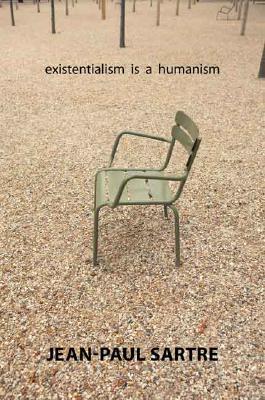
Existentialism Is a Humanism
| AUTHOR | Cohen-Solal, Annie; Macomber, Carol; Sartre, Jean-Paul |
| PUBLISHER | Yale University Press (07/24/2007) |
| PRODUCT TYPE | Paperback (Paperback) |
Description
A fresh translation of two seminal works of existentialism "To understand Jean-Paul Sartre is to understand something important about the present time."--Iris Murdoch "Sartre matters because so many fundamental points of his analysis of the human reality are right and true, and because their accuracy and veracity entail real consequences for our lives as individuals and in social groups."--Benedict O'Donohoe, Philosophy Now It was to correct common misconceptions about his thought that Jean-Paul Sartre, the dominant European intellectual of the post-World War II decades, accepted an invitation to speak on October 29, 1945, at the Club Maintenant in Paris. The unstated objective of his lecture ("Existentialism Is a Humanism") was to expound his philosophy as a form of "existentialism," a term much bandied about at the time. Sartre asserted that existentialism was essentially a doctrine for philosophers, though, ironically, he was about to make it accessible to a general audience. The published text of his lecture quickly became one of the bibles of existentialism and made Sartre an international celebrity. The idea of freedom occupies the center of Sartre's doctrine. Man, born into an empty, godless universe, is nothing to begin with. He creates his essence--his self, his being--through the choices he freely makes ("existence precedes essence"). Were it not for the contingency of his death, he would never end. Choosing to be this or that is to affirm the value of what we choose. In choosing, therefore, we commit not only ourselves but all of mankind. This book presents a new English translation of Sartre's 1945 lecture and his analysis of Camus's The Stranger, along with a discussion of these works by acclaimed Sartre biographer Annie Cohen-Solal. This edition is a translation of the 1996 French edition, which includes Arlette Elkaïm-Sartre's introduction and a Q&A with Sartre about his lecture.
Show More
Product Format
Product Details
ISBN-13:
9780300115468
ISBN-10:
0300115466
Binding:
Paperback or Softback (Trade Paperback (Us))
Content Language:
English
More Product Details
Page Count:
128
Carton Quantity:
96
Product Dimensions:
5.00 x 0.40 x 7.70 inches
Weight:
0.25 pound(s)
Feature Codes:
Bibliography,
Index,
Annotated,
Price on Product,
Table of Contents
Country of Origin:
US
Subject Information
BISAC Categories
Philosophy | Movements - Existentialism
Philosophy | Free Will & Determinism
Dewey Decimal:
142.78
Library of Congress Control Number:
2007002684
Descriptions, Reviews, Etc.
publisher marketing
A fresh translation of two seminal works of existentialism "To understand Jean-Paul Sartre is to understand something important about the present time."--Iris Murdoch "Sartre matters because so many fundamental points of his analysis of the human reality are right and true, and because their accuracy and veracity entail real consequences for our lives as individuals and in social groups."--Benedict O'Donohoe, Philosophy Now It was to correct common misconceptions about his thought that Jean-Paul Sartre, the dominant European intellectual of the post-World War II decades, accepted an invitation to speak on October 29, 1945, at the Club Maintenant in Paris. The unstated objective of his lecture ("Existentialism Is a Humanism") was to expound his philosophy as a form of "existentialism," a term much bandied about at the time. Sartre asserted that existentialism was essentially a doctrine for philosophers, though, ironically, he was about to make it accessible to a general audience. The published text of his lecture quickly became one of the bibles of existentialism and made Sartre an international celebrity. The idea of freedom occupies the center of Sartre's doctrine. Man, born into an empty, godless universe, is nothing to begin with. He creates his essence--his self, his being--through the choices he freely makes ("existence precedes essence"). Were it not for the contingency of his death, he would never end. Choosing to be this or that is to affirm the value of what we choose. In choosing, therefore, we commit not only ourselves but all of mankind. This book presents a new English translation of Sartre's 1945 lecture and his analysis of Camus's The Stranger, along with a discussion of these works by acclaimed Sartre biographer Annie Cohen-Solal. This edition is a translation of the 1996 French edition, which includes Arlette Elkaïm-Sartre's introduction and a Q&A with Sartre about his lecture.
Show More
Author:
Sartre, Jean-Paul
Jean-Paul Sartre was a prolific philosopher, novelist, public intellectual, biographer, playwright and founder of the journal Les Temps Modernes. Born in Paris in 1905 and died in 1980, Sartre was awarded the Nobel Prize for Literature in 1964 and turned it down. His books include Nausea, Intimacy, The Flies, No Exit, Sartre s War Diaries, Critique of Dialectical Reason, and the monumental treatise Being and Nothingness.
Show More
List Price $11.95
Your Price
$11.83