
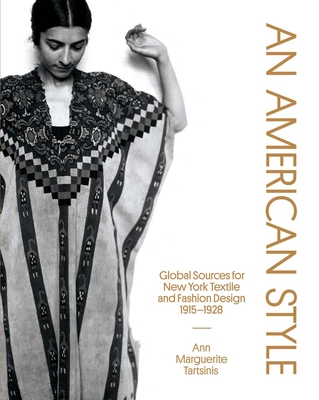
An American Style: Global Sources for New York Textile and Fashion Design, 1915-1928
| AUTHOR | Tartsinis, Ann Marguerite |
| PUBLISHER | Bard Graduate Center (10/15/2013) |
| PRODUCT TYPE | Paperback (Paperback) |
Description
In 1915 the American Museum of Natural History (AMNH) embarked upon a mission to energize the American textile industry. Curators sought to innovate a distinctly "American" design idiom drawing on a more universal "primitive" language. Ethnographic objects were included in study rooms; designers gained access to storage rooms; and museum artifacts were loaned to design houses and department stores. In order to attract designers and reluctant manufacturers, who quickly responded, collections were supplemented with specimens including fur garments from Siberia, Persian costumes, and Javanese textiles. This book positions the project at the AMNH in the broader narrative of early 20th-century design education in New York, which includes the roles of The Metropolitan Museum of Art, the Brooklyn Museum, and the Newark Museum. Distributed for the Bard Graduate Center, New York
Exhibition Schedule:
Bard Graduate Center
(09/27/13-02/19/14)
Show More
Product Format
Product Details
ISBN-13:
9780300199437
ISBN-10:
0300199430
Binding:
Paperback or Softback (Trade Paperback (Us))
Content Language:
English
More Product Details
Page Count:
144
Carton Quantity:
32
Product Dimensions:
7.00 x 0.54 x 8.84 inches
Weight:
0.82 pound(s)
Feature Codes:
Bibliography,
Index,
Price on Product,
Illustrated
Country of Origin:
US
Subject Information
BISAC Categories
Design | Fashion & Accessories
Design | Textile & Costume
Design | Collections, Catalogs, Exhibitions - Group Shows
Dewey Decimal:
746.097
Library of Congress Control Number:
2013024842
Descriptions, Reviews, Etc.
publisher marketing
In 1915 the American Museum of Natural History (AMNH) embarked upon a mission to energize the American textile industry. Curators sought to innovate a distinctly "American" design idiom drawing on a more universal "primitive" language. Ethnographic objects were included in study rooms; designers gained access to storage rooms; and museum artifacts were loaned to design houses and department stores. In order to attract designers and reluctant manufacturers, who quickly responded, collections were supplemented with specimens including fur garments from Siberia, Persian costumes, and Javanese textiles. This book positions the project at the AMNH in the broader narrative of early 20th-century design education in New York, which includes the roles of The Metropolitan Museum of Art, the Brooklyn Museum, and the Newark Museum. Distributed for the Bard Graduate Center, New York
Exhibition Schedule:
Bard Graduate Center
(09/27/13-02/19/14)
Show More
List Price $40.00
Your Price
$39.60