
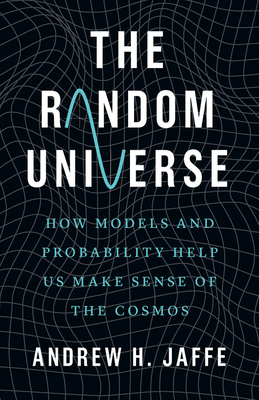
The Random Universe: How Models and Probability Help Us Make Sense of the Cosmos
| AUTHOR | Jaffe, Andrew H. |
| PUBLISHER | Yale University Press (11/11/2025) |
| PRODUCT TYPE | Hardcover (Hardcover) |
Description
An award-winning astrophysicist looks at how the understanding of uncertainty and randomness has led to breakthroughs in our knowledge of the cosmos All of us understand the world around us by constructing models, comparing them to observations, and drawing conclusions. Scientists create, test, and replace these models by applying the twinned concepts of probability and randomness. Exploring how this process has refined our knowledge of quantum mechanics and the birth of the universe, Andrew H. Jaffe offers a unique synthesis of the philosophy of epistemology, the mathematics of probability, and the science of cosmology. As Jaffe puts Enlightenment thinkers like David Hume in conversation with contemporary philosophers such as Karl Popper and Imre Lakatos and engages with scientists ranging from Isaac Newton and Galileo to Albert Einstein and Arthur Eddington, he uses Thomas Bayes's seminal studies of statistics and probability to make sense of conflicting currents of thought. This is a deep look into how we have learned to account for uncertainty in our search for knowledge--and a reminder that science is not about facts and data as such but about creating models that correctly account for those facts and data.
Show More
Product Format
Product Details
ISBN-13:
9780300250503
ISBN-10:
0300250509
Binding:
Hardback or Cased Book (Sewn)
Content Language:
English
More Product Details
Page Count:
288
Carton Quantity:
24
Product Dimensions:
6.10 x 1.10 x 9.40 inches
Weight:
1.01 pound(s)
Feature Codes:
Price on Product
Country of Origin:
US
Subject Information
BISAC Categories
Science | Space Science - Cosmology
Science | Probability & Statistics - Bayesian Analysis
Science | Philosophy & Social Aspects
Descriptions, Reviews, Etc.
publisher marketing
An award-winning astrophysicist looks at how the understanding of uncertainty and randomness has led to breakthroughs in our knowledge of the cosmos All of us understand the world around us by constructing models, comparing them to observations, and drawing conclusions. Scientists create, test, and replace these models by applying the twinned concepts of probability and randomness. Exploring how this process has refined our knowledge of quantum mechanics and the birth of the universe, Andrew H. Jaffe offers a unique synthesis of the philosophy of epistemology, the mathematics of probability, and the science of cosmology. As Jaffe puts Enlightenment thinkers like David Hume in conversation with contemporary philosophers such as Karl Popper and Imre Lakatos and engages with scientists ranging from Isaac Newton and Galileo to Albert Einstein and Arthur Eddington, he uses Thomas Bayes's seminal studies of statistics and probability to make sense of conflicting currents of thought. This is a deep look into how we have learned to account for uncertainty in our search for knowledge--and a reminder that science is not about facts and data as such but about creating models that correctly account for those facts and data.
Show More
List Price $32.50
Your Price
$32.18