
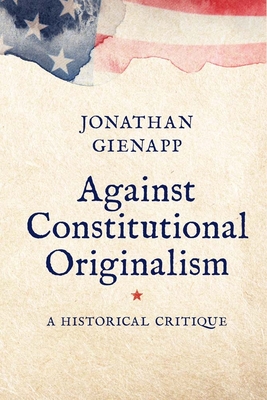
Against Constitutional Originalism: A Historical Critique
| AUTHOR | Gienapp, Jonathan |
| PUBLISHER | Yale University Press (05/06/2025) |
| PRODUCT TYPE | Paperback (Paperback) |
Description
A detailed and compelling examination of how the legal theory of originalism ignores and distorts the very constitutional history from which it derives interpretive authority "What are the chances that, in 2024, a new book could fundamentally reorient how we understand America's founding? Jonathan Gienapp . . . has written such a book. . . . You read it, and you get vertigo. . . . Gienapp's book comes as a thunderclap."--Cass Sunstein, Washington Post Longlisted for the Cundill History Prize, 2025 - History Today Book of the Year, 2024 Constitutional originalism stakes law to history. The theory's core tenet--that the U.S. Constitution should be interpreted according to its original meaning--has us decide questions of modern constitutional law by consulting the distant constitutional past. Yet originalist engagement with history is often deeply problematic. And now that a majority of justices on the U.S. Supreme Court champion originalism, the task of scrutinizing originalists' use and abuse of history has never been more urgent. In this comprehensive and novel critique of originalism, Jonathan Gienapp targets originalists' unspoken assumptions about the Constitution and its history. Originalists are committed to recovering the Constitution laid down at the American Founding, yet they often assume that the Constitution is fundamentally modern. Rather than recovering the original Constitution, they project their own understandings onto it, assuming that eighteenth-century constitutional thinking was no different than their own. They take for granted what it meant to write a constitution down, what law was, how it worked, and where it came from, and how a constitution's meaning was fixed. In the process, they erase the Constitution that eighteenth-century Americans in fact created. By understanding how originalism fails, we can better understand the Constitution that we have.
Show More
Product Format
Product Details
ISBN-13:
9780300284874
ISBN-10:
030028487X
Binding:
Paperback or Softback (Trade Paperback (Us))
Content Language:
English
More Product Details
Page Count:
368
Carton Quantity:
28
Product Dimensions:
5.50 x 1.00 x 8.40 inches
Weight:
0.80 pound(s)
Feature Codes:
Price on Product
Country of Origin:
US
Subject Information
BISAC Categories
Law | Constitutional
Law | American Government - Judicial Branch
Law | Political Ideologies - Conservatism & Liberalism
Descriptions, Reviews, Etc.
publisher marketing
A detailed and compelling examination of how the legal theory of originalism ignores and distorts the very constitutional history from which it derives interpretive authority "What are the chances that, in 2024, a new book could fundamentally reorient how we understand America's founding? Jonathan Gienapp . . . has written such a book. . . . You read it, and you get vertigo. . . . Gienapp's book comes as a thunderclap."--Cass Sunstein, Washington Post Longlisted for the Cundill History Prize, 2025 - History Today Book of the Year, 2024 Constitutional originalism stakes law to history. The theory's core tenet--that the U.S. Constitution should be interpreted according to its original meaning--has us decide questions of modern constitutional law by consulting the distant constitutional past. Yet originalist engagement with history is often deeply problematic. And now that a majority of justices on the U.S. Supreme Court champion originalism, the task of scrutinizing originalists' use and abuse of history has never been more urgent. In this comprehensive and novel critique of originalism, Jonathan Gienapp targets originalists' unspoken assumptions about the Constitution and its history. Originalists are committed to recovering the Constitution laid down at the American Founding, yet they often assume that the Constitution is fundamentally modern. Rather than recovering the original Constitution, they project their own understandings onto it, assuming that eighteenth-century constitutional thinking was no different than their own. They take for granted what it meant to write a constitution down, what law was, how it worked, and where it came from, and how a constitution's meaning was fixed. In the process, they erase the Constitution that eighteenth-century Americans in fact created. By understanding how originalism fails, we can better understand the Constitution that we have.
Show More
List Price $22.00
Your Price
$21.78