
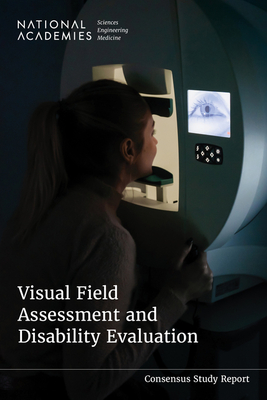
Visual Field Assessment and Disability Evaluation
| AUTHOR | Board on Health Care Services; National Academies of Sciences Engineering and Medicine; Health and Medicine Division |
| PUBLISHER | National Academies Press (09/11/2025) |
| PRODUCT TYPE | Paperback (Paperback) |
Visual field is the total area of space a person can see when the eyes are focused on a central point. Impairment of the visual field can have significant negative effects on well-being. Individuals with moderate to severe visual field loss may have difficulty performing routine tasks, such as reading, driving, and navigating environments, as well as engaging in social activities. More profound loss leads to greater disability and poorer quality of life. Nearly 8 million people in the U.S. indicate they have blindness or difficulty seeing even while wearing corrective lenses, and the prevalence of visual impairment among U.S. preschool-aged children may be as high as five percent.
Testing for visual field impairment involves a combination of hardware, stimuli, testing patterns, and algorithms. The Social Security Administration (SSA) uses the results of such testing to determine whether applicants for disability based on visual field loss qualify for benefits. In response to a request from SSA, the National Academies convened a committee of experts to review the research and science on methods for testing visual field impairment. The resulting report reviews current and emerging practices and known limitations in visual field testing and offers conclusions to inform disability evaluations.
Visual field is the total area of space a person can see when the eyes are focused on a central point. Impairment of the visual field can have significant negative effects on well-being. Individuals with moderate to severe visual field loss may have difficulty performing routine tasks, such as reading, driving, and navigating environments, as well as engaging in social activities. More profound loss leads to greater disability and poorer quality of life. Nearly 8 million people in the U.S. indicate they have blindness or difficulty seeing even while wearing corrective lenses, and the prevalence of visual impairment among U.S. preschool-aged children may be as high as five percent.
Testing for visual field impairment involves a combination of hardware, stimuli, testing patterns, and algorithms. The Social Security Administration (SSA) uses the results of such testing to determine whether applicants for disability based on visual field loss qualify for benefits. In response to a request from SSA, the National Academies convened a committee of experts to review the research and science on methods for testing visual field impairment. The resulting report reviews current and emerging practices and known limitations in visual field testing and offers conclusions to inform disability evaluations.