
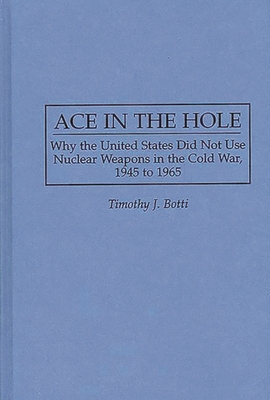
Ace in the Hole: Why the United States Did Not Use Nuclear Weapons in the Cold War, 1945 to 1965
| AUTHOR | Botti, Timothy J. |
| PUBLISHER | Praeger (06/21/1996) |
| PRODUCT TYPE | Hardcover (Hardcover) |
Description
Using newly released documents, the author presents an integrated look at American nuclear policy and diplomacy in crises from the Berlin blockade to Vietnam. The book answers the question why, when the atomic bomb had been used with such devastating effect against the Japanese Empire in 1945, American leaders put this most apocalyptic of weapons back on the shelf, never to be used again in anger. It documents the myopia of Potomac strategists in involving the U.S. in wars of attrition in Korea and Southeast Asia, marginal areas where American vital interests were in no way endangered. Despite the presence of hundreds, then thousands of nuclear bombs and warheads in the nation's stockpile, the greatest military weapon in history became politically impossible to use. And yet overwhelming nuclear superiority did serve its ultimate purpose in the Cold War. When American vital interests were threatened--over Berlin and Cuba--the Soviets backed down from confrontation. Despite errors in strategic judgment brought on by fear of Communist expansion, and in some cases outright incompetence, the ace in the hole proved decisive.
Show More
Product Format
Product Details
ISBN-13:
9780313299766
ISBN-10:
0313299765
Binding:
Hardback or Cased Book (Sewn)
Content Language:
English
More Product Details
Page Count:
328
Carton Quantity:
26
Product Dimensions:
6.33 x 1.07 x 9.58 inches
Weight:
1.35 pound(s)
Feature Codes:
Bibliography,
Dust Cover
Country of Origin:
US
Subject Information
BISAC Categories
Technology & Engineering | Military Science
Technology & Engineering | United States - 20th Century
Technology & Engineering | Americas (North Central South West Indies)
Accelerated Reader:
Reading Level:
0
Point Value:
0
Guided Reading Level:
Not Applicable
Dewey Decimal:
355.027
Library of Congress Control Number:
95050451
Descriptions, Reviews, Etc.
publisher marketing
Using newly released documents, the author presents an integrated look at American nuclear policy and diplomacy in crises from the Berlin blockade to Vietnam. The book answers the question why, when the atomic bomb had been used with such devastating effect against the Japanese Empire in 1945, American leaders put this most apocalyptic of weapons back on the shelf, never to be used again in anger. It documents the myopia of Potomac strategists in involving the U.S. in wars of attrition in Korea and Southeast Asia, marginal areas where American vital interests were in no way endangered. Despite the presence of hundreds, then thousands of nuclear bombs and warheads in the nation's stockpile, the greatest military weapon in history became politically impossible to use. And yet overwhelming nuclear superiority did serve its ultimate purpose in the Cold War. When American vital interests were threatened--over Berlin and Cuba--the Soviets backed down from confrontation. Despite errors in strategic judgment brought on by fear of Communist expansion, and in some cases outright incompetence, the ace in the hole proved decisive.
Show More
Author:
Botti, Timothy J.
TIMOTHY J.BOTTI holds a Ph.D. in American Foreign Policy History from Ohio State University, and is a historian and former Lecturer/Teaching Assistant at Ohio State University.
Show More
Your Price
$99.00