
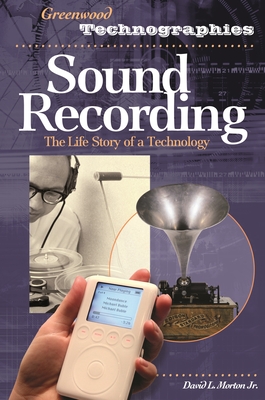
Sound Recording: The Life Story of a Technology
| AUTHOR | Morton, David |
| PUBLISHER | Greenwood (09/01/2004) |
| PRODUCT TYPE | Hardcover (Hardcover) |
How did one of the great inventions of the 19th century-- Thomas Edison's phonograph-- eventually lead to one of the most culturally and economically significant technologies of the 20th and 21st centuries? Sound Recording tells that story, tracing the history of the business boom and the cultural revolution begun by Edison's invention. Ever since, recorded sound has been all around us--not just in reproducing and playing popular music, but also in more mundane areas, such as office dictation machines, radio and television programs, and even telephone answering machines. Just as the styles of music have evolved over the years, the formats on which this music was played have changed as well --from 78s to LPs, from LPs to cassette tapes, from cassettes to CDs--not to mention lesser-known innovations in the motion picture and television industries. The quest for better sound was one of the drivers of technological change, but so too were business strategies, patent battles, and a host of other factors.
Sound Recording contains much information that will interest anyone interested in the history of recorded music and sound technology, such as:- The world-famous composer John Phillip Sousa once denounced sound recordings as a threat to good musical tasted. He nonetheless made many recordings over the years
- Two innovative new products were introduced by RCA in 1958--the first modern cassette tape cartridge and the stereophonic LP record. The tape cartridge, which was about the size of a large paperback, flopped almost immediately; the stereo LP was the music industry's biggest hit ever
- Chrysler automobiles of the late 1950s offered Highway Hi-Fi, a dashboard phonograph that could play a record without skipping
- The predecessor of the Compact Disc was a 12-inch home videodisc system from the late 1970s--the first of its kind--called DiscoVision The volume includes a timeline and a bibliography for those interested in delving further into the history of recorded sound.
How did one of the great inventions of the 19th century-- Thomas Edison's phonograph-- eventually lead to one of the most culturally and economically significant technologies of the 20th and 21st centuries? Sound Recording tells that story, tracing the history of the business boom and the cultural revolution begun by Edison's invention. Ever since, recorded sound has been all around us--not just in reproducing and playing popular music, but also in more mundane areas, such as office dictation machines, radio and television programs, and even telephone answering machines. Just as the styles of music have evolved over the years, the formats on which this music was played have changed as well --from 78s to LPs, from LPs to cassette tapes, from cassettes to CDs--not to mention lesser-known innovations in the motion picture and television industries. The quest for better sound was one of the drivers of technological change, but so too were business strategies, patent battles, and a host of other factors.
Sound Recording contains much information that will interest anyone interested in the history of recorded music and sound technology, such as:- The world-famous composer John Phillip Sousa once denounced sound recordings as a threat to good musical tasted. He nonetheless made many recordings over the years
- Two innovative new products were introduced by RCA in 1958--the first modern cassette tape cartridge and the stereophonic LP record. The tape cartridge, which was about the size of a large paperback, flopped almost immediately; the stereo LP was the music industry's biggest hit ever
- Chrysler automobiles of the late 1950s offered Highway Hi-Fi, a dashboard phonograph that could play a record without skipping
- The predecessor of the Compact Disc was a 12-inch home videodisc system from the late 1970s--the first of its kind--called DiscoVision The volume includes a timeline and a bibliography for those interested in delving further into the history of recorded sound.