
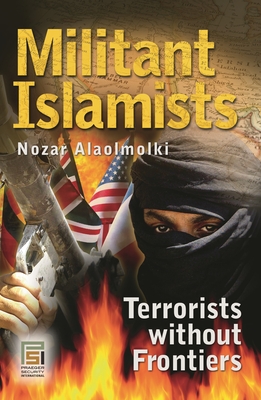
Militant Islamists: Terrorists Without Frontiers
| AUTHOR | Alaolmolki, Nozar |
| PUBLISHER | Praeger (05/30/2009) |
| PRODUCT TYPE | Hardcover (Hardcover) |
Description
In this book, Alaolmolki, an expert on the transnational politics of Central Asia and the Persian Gulf, provides a global view of militant Islamist ideologies, activities, and connections. Unlike many extant books on this topic, Militant Islamists does not examine only one particular factor or driving force in political violence such as suicide bombings; rather, this work studies transnational militant Islam on several levels: domestic (e.g., the role of poverty and lack of democracy in Arab and Muslim nations); regional (e.g., the Palestinian-Israeli conflict; Hizbullah in Lebanon; Jemmah Islamiyan in Southeast Asia; Hizb al-Tahrir in Central Asia); global (e.g., the role of the United States and Western Europe in inadvertently helping transnational Islamists). Ultimately, the author traces the effects of the U.S.-led invasions of Afghanistan and Iraq on militant Islamist terrorism, concluding that militant Islam is spreading, not receding, and that the United States would better rely on soft, rather than hard (military), power to overcome it.
Show More
Product Format
Product Details
ISBN-13:
9780313372216
ISBN-10:
0313372217
Binding:
Hardback or Cased Book (Unsewn / Adhesive Bound)
Content Language:
English
More Product Details
Page Count:
232
Carton Quantity:
30
Product Dimensions:
6.40 x 1.10 x 9.30 inches
Weight:
1.10 pound(s)
Feature Codes:
Bibliography,
Index,
Dust Cover,
Table of Contents,
Glossary
Country of Origin:
US
Subject Information
BISAC Categories
Reference | General
Reference | Military - General
Dewey Decimal:
363.325
Library of Congress Control Number:
2009010073
Descriptions, Reviews, Etc.
publisher marketing
In this book, Alaolmolki, an expert on the transnational politics of Central Asia and the Persian Gulf, provides a global view of militant Islamist ideologies, activities, and connections. Unlike many extant books on this topic, Militant Islamists does not examine only one particular factor or driving force in political violence such as suicide bombings; rather, this work studies transnational militant Islam on several levels: domestic (e.g., the role of poverty and lack of democracy in Arab and Muslim nations); regional (e.g., the Palestinian-Israeli conflict; Hizbullah in Lebanon; Jemmah Islamiyan in Southeast Asia; Hizb al-Tahrir in Central Asia); global (e.g., the role of the United States and Western Europe in inadvertently helping transnational Islamists). Ultimately, the author traces the effects of the U.S.-led invasions of Afghanistan and Iraq on militant Islamist terrorism, concluding that militant Islam is spreading, not receding, and that the United States would better rely on soft, rather than hard (military), power to overcome it.
Show More
Your Price
$89.10