
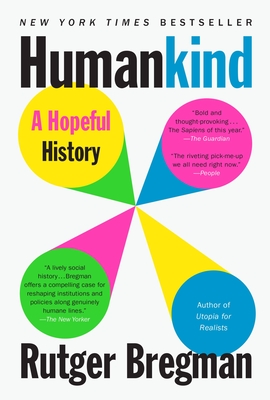
Humankind: A Hopeful History
| AUTHOR | Moore, Erica; Bregman, Rutger; Manton, Elizabeth |
| PUBLISHER | Back Bay Books (11/16/2021) |
| PRODUCT TYPE | Paperback (Paperback) |
Description
AN INSTANT NEW YORK TIMES BESTSELLER The "lively" (The New Yorker), "convincing" (Forbes), and "riveting pick-me-up we all need right now" (People) that proves humanity thrives in a crisis and that our innate kindness and cooperation have been the greatest factors in our long-term success as a species. If there is one belief that has united the left and the right, psychologists and philosophers, ancient thinkers and modern ones, it is the tacit assumption that humans are bad. It's a notion that drives newspaper headlines and guides the laws that shape our lives. From Machiavelli to Hobbes, Freud to Pinker, the roots of this belief have sunk deep into Western thought. Human beings, we're taught, are by nature selfish and governed primarily by self-interest. But what if it isn't true? International bestseller Rutger Bregman provides new perspective on the past 200,000 years of human history, setting out to prove that we are hardwired for kindness, geared toward cooperation rather than competition, and more inclined to trust rather than distrust one another. In fact this instinct has a firm evolutionary basis going back to the beginning of Homo sapiens. From the real-life Lord of the Flies to the solidarity in the aftermath of the Blitz, the hidden flaws in the Stanford prison experiment to the true story of twin brothers on opposite sides who helped Mandela end apartheid, Bregman shows us that believing in human generosity and collaboration isn't merely optimistic--it's realistic. Moreover, it has huge implications for how society functions. When we think the worst of people, it brings out the worst in our politics and economics. But if we believe in the reality of humanity's kindness and altruism, it will form the foundation for achieving true change in society, a case that Bregman makes convincingly with his signature wit, refreshing frankness, and memorable storytelling. "The Sapiens of 2020." --The Guardian "Humankind made me see humanity from a fresh perspective." --Yuval Noah Harari, author of the #1 bestseller Sapiens Longlisted for the 2021 Andrew Carnegie Medal for Excellence in Nonfiction One of the Washington Post's 50 Notable Nonfiction Works in 2020
Show More
Product Format
Product Details
ISBN-13:
9780316418522
ISBN-10:
0316418528
Binding:
Paperback or Softback (Trade Paperback (Us))
Content Language:
English
More Product Details
Page Count:
480
Carton Quantity:
20
Product Dimensions:
5.40 x 1.40 x 8.00 inches
Weight:
0.95 pound(s)
Feature Codes:
Bibliography,
Index,
Price on Product,
Maps,
Illustrated
Country of Origin:
US
Subject Information
BISAC Categories
History | World - General
History | Civilization
History | Sociology - Social Theory
Dewey Decimal:
128
Descriptions, Reviews, Etc.
publisher marketing
AN INSTANT NEW YORK TIMES BESTSELLER The "lively" (The New Yorker), "convincing" (Forbes), and "riveting pick-me-up we all need right now" (People) that proves humanity thrives in a crisis and that our innate kindness and cooperation have been the greatest factors in our long-term success as a species. If there is one belief that has united the left and the right, psychologists and philosophers, ancient thinkers and modern ones, it is the tacit assumption that humans are bad. It's a notion that drives newspaper headlines and guides the laws that shape our lives. From Machiavelli to Hobbes, Freud to Pinker, the roots of this belief have sunk deep into Western thought. Human beings, we're taught, are by nature selfish and governed primarily by self-interest. But what if it isn't true? International bestseller Rutger Bregman provides new perspective on the past 200,000 years of human history, setting out to prove that we are hardwired for kindness, geared toward cooperation rather than competition, and more inclined to trust rather than distrust one another. In fact this instinct has a firm evolutionary basis going back to the beginning of Homo sapiens. From the real-life Lord of the Flies to the solidarity in the aftermath of the Blitz, the hidden flaws in the Stanford prison experiment to the true story of twin brothers on opposite sides who helped Mandela end apartheid, Bregman shows us that believing in human generosity and collaboration isn't merely optimistic--it's realistic. Moreover, it has huge implications for how society functions. When we think the worst of people, it brings out the worst in our politics and economics. But if we believe in the reality of humanity's kindness and altruism, it will form the foundation for achieving true change in society, a case that Bregman makes convincingly with his signature wit, refreshing frankness, and memorable storytelling. "The Sapiens of 2020." --The Guardian "Humankind made me see humanity from a fresh perspective." --Yuval Noah Harari, author of the #1 bestseller Sapiens Longlisted for the 2021 Andrew Carnegie Medal for Excellence in Nonfiction One of the Washington Post's 50 Notable Nonfiction Works in 2020
Show More
List Price $22.99
Your Price
$22.76