
Available options are listed below:
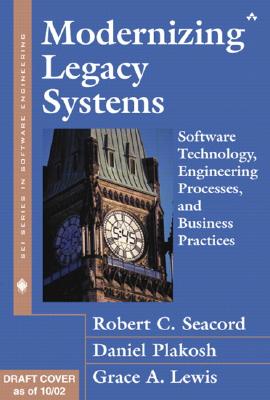
Modernizing Legacy Systems: Software Technologies, Engineering Processes, and Business Practices (Out of print)
| AUTHOR | Seacord, Robert; Peter Gordon; John Fuller et al. |
| PUBLISHER | Addison-Wesley Professional (02/13/2003) |
| PRODUCT TYPE | Paperback (Paperback) |
Most organizations rely on complex enterprise information systems (EISs) to codify their business practices and collect, process, and analyze business data. These EISs are large, heterogeneous, distributed, constantly evolving, dynamic, long-lived, and mission critical. In other words, they are a complicated system of systems. As features are added to an EIS, new technologies and components are selected and integrated. In many ways, these information systems are to an enterprise what a brain is to the higher species--a complex, poorly understood mass upon which the organism relies for its very existence. To optimize business value, these large, complex systems must be modernized--but where does one begin? This book uses an extensive real-world case study (based on the modernization of a thirty year old retail system) to show how modernizing legacy systems can deliver significant business value to any organization.
"The potential impact of this book cannot be overstressed. Software systems that are not continually and adequately evolved and, in particular, legacy systems that have not been so maintained, can threaten an organization's very survival. I recommend the book as a must for people directly involved in such evolution, whether as customers, managers and resource providers, or as implementers."
Businesses inevitably face a critical choice in the design and maintenance of their software systems: Dismantle older systems and completely replace them, or incrementally modernize existing systems. Many businesses choose the latter course, seeking to maximize their existing investment and preserve valuable business knowledge, while adapting to rapidly evolving technologies. Modernizing Legacy Systems is a much-needed guide, showing how to implement a successful modernization strategy and describing specifically a risk-managed, incremental approach--one that encompasses changes in software technologies, engineering processes, and business practices.
Key topics include:
- Making a case for modernization
- Understanding requirements and constraints
- Maintaining performance, data integrity, and security
- Designing and deploying the target architecture
- Migrating code and data
- Estimating costs
- Planning the modernization effort
For every topic, this book presents current standards and available products that support legacy system modernization. In addition, a large retail-supply-system case study--a system written in COBOL being modernized to one based on the J2EE architecture--runs throughout this book to demonstrate a real-world legacy system modernization effort.
0321118847B01232003Most organizations rely on complex enterprise information systems (EISs) to codify their business practices and collect, process, and analyze business data. These EISs are large, heterogeneous, distributed, constantly evolving, dynamic, long-lived, and mission critical. In other words, they are a complicated system of systems. As features are added to an EIS, new technologies and components are selected and integrated. In many ways, these information systems are to an enterprise what a brain is to the higher species--a complex, poorly understood mass upon which the organism relies for its very existence. To optimize business value, these large, complex systems must be modernized--but where does one begin? This book uses an extensive real-world case study (based on the modernization of a thirty year old retail system) to show how modernizing legacy systems can deliver significant business value to any organization.