
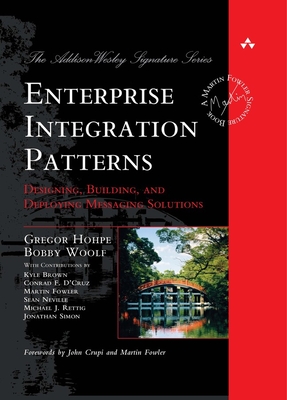
Enterprise Integration Patterns: Designing, Building, and Deploying Messaging Solutions
| AUTHOR | Woolf, Bobby; Hohpe, Gregor |
| PUBLISHER | Addison-Wesley Professional (10/10/2003) |
| PRODUCT TYPE | Hardcover (Hardcover) |
Utilizing years of practical experience, seasoned experts Gregor Hohpe and Bobby Woolf show how asynchronous messaging has proven to be the best strategy for enterprise integration success. However, building and deploying messaging solutions presents a number of problems for developers. Enterprise Integration Patterns provides an invaluable catalog of sixty-five patterns, with real-world solutions that demonstrate the formidable of messaging and help you to design effective messaging solutions for your enterprise.
The authors also include examples covering a variety of different integration technologies, such as JMS, MSMQ, TIBCO ActiveEnterprise, Microsoft BizTalk, SOAP, and XSL. A case study describing a bond trading system illustrates the patterns in practice, and the book offers a look at emerging standards, as well as insights into what the future of enterprise integration might hold.
This book provides a consistent vocabulary and visual notation framework to describe large-scale integration solutions across many technologies. It also explores in detail the advantages and limitations of asynchronous messaging architectures. The authors present practical advice on designing code that connects an application to a messaging system, and provide extensive information to help you determine when to send a message, how to route it to the proper destination, and how to monitor the health of a messaging system. If you want to know how to manage, monitor, and maintain a messaging system once it is in use, get this book.
0321200683B09122003Utilizing years of practical experience, seasoned experts Gregor Hohpe and Bobby Woolf show how asynchronous messaging has proven to be the best strategy for enterprise integration success. However, building and deploying messaging solutions presents a number of problems for developers. Enterprise Integration Patterns provides an invaluable catalog of sixty-five patterns, with real-world solutions that demonstrate the formidable of messaging and help you to design effective messaging solutions for your enterprise.
The authors also include examples covering a variety of different integration technologies, such as JMS, MSMQ, TIBCO ActiveEnterprise, Microsoft BizTalk, SOAP, and XSL. A case study describing a bond trading system illustrates the patterns in practice, and the book offers a look at emerging standards, as well as insights into what the future of enterprise integration might hold.
This book provides a consistent vocabulary and visual notation framework to describe large-scale integration solutions across many technologies. It also explores in detail the advantages and limitations of asynchronous messaging architectures. The authors present practical advice on designing code that connects an application to a messaging system, and provide extensive information to help you determine when to send a message, how to route it to the proper destination, and how to monitor the health of a messaging system. If you want to know how to manage, monitor, and maintain a messaging system once it is in use, get this book.
0321200683B09122003