
Back to Search

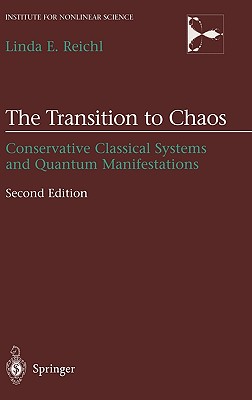
The Transition to Chaos: Conservative Classical Systems and Quantum Manifestations

AUTHOR Reichl, Linda
PUBLISHER Springer (05/13/2004)
PRODUCT TYPE Hardcover (Hardcover)

Description
Based on courses given at the universities of Texas in Austin, and California in San Diego, this book deals with the basic mechanisms that determine the dynamic evolution of classical and quantum systems. It presents, in as simple a manner as possible, the basic mechanisms that determine the dynamical evolution of both classical and quantum systems in sufficient generality to include quantum phenomena. The book begins with a discussion of Noether's theorem, integrability, KAM theory, and a definition of chaotic behavior; it continues with a detailed discussion of area-preserving maps, integrable quantum systems, spectral properties, path integrals, and periodically driven systems; and it concludes by showing how to apply the ideas to stochastic systems. The presentation is complete and self-contained; appendices provide much of the needed mathematical background, and there are extensive references to the current literature. Problems at the ends of chapters help students clarify their understanding. In this new edition, the presentation will be brought up to date throughout, and a new chapter on open quantum systems will be added.
Show More
Product Format
Product Details
ISBN-13: 9780387987880
ISBN-10: 0387987886
Binding: Hardback or Cased Book (Sewn)
Content Language: English
Edition Number: 0002
More Product Details
Page Count: 675
Carton Quantity: 12
Product Dimensions: 6.10 x 1.40 x 9.30 inches
Weight: 2.35 pound(s)
Feature Codes: Bibliography, Index, Maps, Table of Contents, Illustrated
Country of Origin: US
Subject Information
BISAC Categories
Science | Chaotic Behavior in Systems
Science | Physics - Quantum Theory
Science | System Theory
Dewey Decimal: 003.857
Library of Congress Control Number: 2003062211
Descriptions, Reviews, Etc.
jacket back

This book provides a thorough and comprehensive discussion of classical and quantum chaos theory for bounded systems and for scattering processes. Specific discussions include:

- Noether's theorem, integrability, KAM theory, and a definition of chaotic behavior.

- Area-preserving maps, quantum billiards, semiclassical quantization, chaotic scattering, scaling in classical and quantum dynamics, dynamic localization, dynamic tunneling, effects of chaos in periodically driven systems and stochastic systems.

- Random matrix theory and supersymmetry.

The book is divided into several parts. Chapters 2 through 4 deal with the dynamics of nonlinear conservative classical systems. Chapter 5 and several appendices give a thorough grounding in random matrix theory and supersymmetry techniques. Chapters 6 and 7 discuss the manifestations of chaos in bounded quantum systems and open quantum systems respectively. Chapter 8 focuses on the semiclassical description of quantum systems with underlying classical chaos, and Chapter 9 discusses the quantum mechanics of systems driven by time-periodic forces. Chapter 10 reviews some recent work on the stochastic manifestations of chaos.

The presentation is complete and self-contained; appendices provide much of the needed mathematical background, and there are extensive references to the current literature. End of chapter problems help students clarify their understanding. In this new edition, the presentation has been brought up to date throughout, and a new chapter on open quantum systems has been added.

About the author:

Linda E. Reichl, Ph.D., is a Professor of Physics at the University of Texas at Austin and has served as Acting Director of the Ilya Prigogine Center for Statistical Mechanics and Complex Systems since 1974. She is a Fellow of the American Physical Society and currently is U.S. Editor ofthe journal Chaos, Solitons, and Fractals.

Show More
publisher marketing
Based on courses given at the universities of Texas in Austin, and California in San Diego, this book deals with the basic mechanisms that determine the dynamic evolution of classical and quantum systems. It presents, in as simple a manner as possible, the basic mechanisms that determine the dynamical evolution of both classical and quantum systems in sufficient generality to include quantum phenomena. The book begins with a discussion of Noether's theorem, integrability, KAM theory, and a definition of chaotic behavior; it continues with a detailed discussion of area-preserving maps, integrable quantum systems, spectral properties, path integrals, and periodically driven systems; and it concludes by showing how to apply the ideas to stochastic systems. The presentation is complete and self-contained; appendices provide much of the needed mathematical background, and there are extensive references to the current literature. Problems at the ends of chapters help students clarify their understanding. In this new edition, the presentation will be brought up to date throughout, and a new chapter on open quantum systems will be added.
Show More
List Price $54.99
Your Price  $54.44
Hardcover