
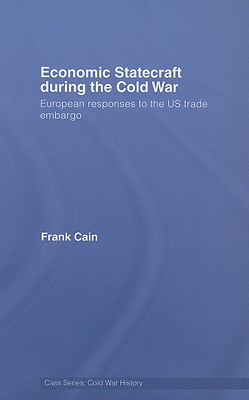
Economic Statecraft During the Cold War: European Responses to the Us Trade Embargo
| AUTHOR | Cain, Frank |
| PUBLISHER | Routledge (10/19/2006) |
| PRODUCT TYPE | Hardcover (Hardcover) |
Discussing a rarely researched aspect of the Cold War, this volume uses new material to examine how the United States trade embargo on the Soviet Union and communist China severed relationships with Europe, particularly focusing on Great Britain.
In the late 1940s, the US government stopped nearly all exports to the entire Sino-Soviet bloc in the belief that it would hinder the expansion of Soviet and Chinese military potential. To continue receiving the US Marshall Aid, European countries had to impose similar bans, but were reluctant because their trade links with the USSR and its satellite countries had existed for centuries. The US thereafter negotiated with Europe about what to include or exclude from the list of authorised goods, severely straining diplomatic relations.
Economic Statecraft during the Cold War details these negotiations, casting new light on the ambivalent US-UK relationship and providing insights into the changing emphasis between the Republican and Democrat administrations on the key question of trade embargo, by explaining how the firm consistency in the application of the US policy over the succeeding decades of the Cold War was maintained.
This book will be of much interest to all students and scholars of Cold War history, intelligence studies and international history in general.
Discussing a rarely researched aspect of the Cold War, this volume uses new material to examine how the United States trade embargo on the Soviet Union and communist China severed relationships with Europe, particularly focusing on Great Britain.
In the late 1940s, the US government stopped nearly all exports to the entire Sino-Soviet bloc in the belief that it would hinder the expansion of Soviet and Chinese military potential. To continue receiving the US Marshall Aid, European countries had to impose similar bans, but were reluctant because their trade links with the USSR and its satellite countries had existed for centuries. The US thereafter negotiated with Europe about what to include or exclude from the list of authorised goods, severely straining diplomatic relations.
Economic Statecraft during the Cold War details these negotiations, casting new light on the ambivalent US-UK relationship and providing insights into the changing emphasis between the Republican and Democrat administrations on the key question of trade embargo, by explaining how the firm consistency in the application of the US policy over the succeeding decades of the Cold War was maintained.
This book will be of much interest to all students and scholars of Cold War history, intelligence studies and international history in general.