
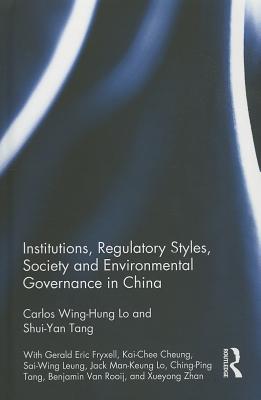
Institutions, Regulatory Styles, Society and Environmental Governance in China
| AUTHOR | Lo, Carlos Wing-Hung; Tang, Shui-Yan |
| PUBLISHER | Routledge (07/10/2013) |
| PRODUCT TYPE | Hardcover (Hardcover) |
During the past three decades of rapid industrial growth, China has suffered from devastating environmental degradation. Most scholarly and popular publications have painted a rather pessimistic picture about the worrisome trend. Yet a somewhat more optimistic view has emerged in the past decade given the Chinese government's increased commitment to fighting industrial pollution, the public's increased concerns regarding the adverse effects of pollution, and domestic and international civil society's increased involvement in promoting environmental protection in China.
Drawing on the authors' extensive research on Guangdong Province and a few large cities in other provinces, this book provides an in-depth study on China's environmental governance and regulatory enforcement in the past two decades. Section 1 examines various institutional constraints for environmental regulation enforcement at the local level and how governance reform efforts in the past decade have contributed to the lessening of those constraints. Section 2 draws on data derived from surveys and interviews conducted in multiple cities and times; it examines the dominant regulatory enforcement styles of local environmental protection bureaus and how these styles vary across different regions and over time. Section 3 examines how various stakeholders-the general public, environmental groups, government entities, and corporations-affect the environmental governance process.
Overall, the book presents a cautiously optimistic view on the evolution of environmental governance in China. While highlighting many political, institutional, social, and economic constraints, it also documents many changes that have taken place-including reform efforts from within the government administrative system, increasingly societal concerns and actions, and changing attitudes among corporate executives-potentially paving the way for more effective environmental governance in the future.
During the past three decades of rapid industrial growth, China has suffered from devastating environmental degradation. Most scholarly and popular publications have painted a rather pessimistic picture about the worrisome trend. Yet a somewhat more optimistic view has emerged in the past decade given the Chinese government's increased commitment to fighting industrial pollution, the public's increased concerns regarding the adverse effects of pollution, and domestic and international civil society's increased involvement in promoting environmental protection in China.
Drawing on the authors' extensive research on Guangdong Province and a few large cities in other provinces, this book provides an in-depth study on China's environmental governance and regulatory enforcement in the past two decades. Section 1 examines various institutional constraints for environmental regulation enforcement at the local level and how governance reform efforts in the past decade have contributed to the lessening of those constraints. Section 2 draws on data derived from surveys and interviews conducted in multiple cities and times; it examines the dominant regulatory enforcement styles of local environmental protection bureaus and how these styles vary across different regions and over time. Section 3 examines how various stakeholders-the general public, environmental groups, government entities, and corporations-affect the environmental governance process.
Overall, the book presents a cautiously optimistic view on the evolution of environmental governance in China. While highlighting many political, institutional, social, and economic constraints, it also documents many changes that have taken place-including reform efforts from within the government administrative system, increasingly societal concerns and actions, and changing attitudes among corporate executives-potentially paving the way for more effective environmental governance in the future.