
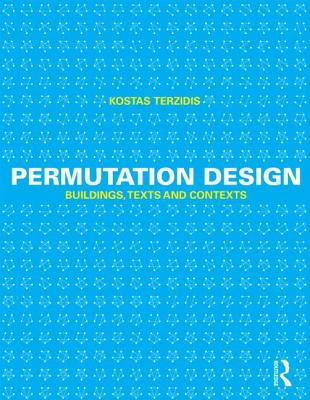
Permutation Design: Buildings, Texts, and Contexts
| AUTHOR | Terzidis, Kostas |
| PUBLISHER | Routledge (10/16/2014) |
| PRODUCT TYPE | Paperback (Paperback) |
In design, the problems that designers are called upon to solve can be regarded as a problem of permutations. A permutation is an ordered arrangement of elements in a set. In our case, the set is design and the elements are design components, such as lines, shapes, forms, or spaces.
Traditionally, such arrangements are done by human designers who base their decision-making process either on intuition or on random sampling until a valid solution is found. However, in both cases the solution found may be an acceptable one but cannot be labeled as "the best possible solution" due to the subjective or arbitrary nature of the selection process. In contrast, by harnessing the potential of computational design, these elements can be arranged in all possible ways and then the best ones are chosen based on specific criteria. By presenting a complete list of permutation-based arrangements the "best solution" will eventually reveal itself by excluding all other possible solutions.
This book comprehensively addresses theories, techniques, and examples of permutation design in order to fully demonstrate to the reader the full range of possibilities this method represents. The significance of such an approach to design is enormous, paradigmatic, and far-reaching. It provides an alternative method for design analysis, synthesis, and evaluation that is based on computational force rather than pure human intelligence alone. In contrast to human-based random sampling or intuition, permutation-based design offers the assurance of an optimum design since any possible alternative design can be eliminated. From a practical point of view, this methodology offers a paradigmatic shift away from the current state of design practice where arbitrariness, repetition, and redundancy often exist. From a theoretical viewpoint, this new paradigm will offer alternative insights into the value of human creativity, intuition, and intelligence.
In design, the problems that designers are called upon to solve can be regarded as a problem of permutations. A permutation is an ordered arrangement of elements in a set. In our case, the set is design and the elements are design components, such as lines, shapes, forms, or spaces.
Traditionally, such arrangements are done by human designers who base their decision-making process either on intuition or on random sampling until a valid solution is found. However, in both cases the solution found may be an acceptable one but cannot be labeled as "the best possible solution" due to the subjective or arbitrary nature of the selection process. In contrast, by harnessing the potential of computational design, these elements can be arranged in all possible ways and then the best ones are chosen based on specific criteria. By presenting a complete list of permutation-based arrangements the "best solution" will eventually reveal itself by excluding all other possible solutions.
This book comprehensively addresses theories, techniques, and examples of permutation design in order to fully demonstrate to the reader the full range of possibilities this method represents. The significance of such an approach to design is enormous, paradigmatic, and far-reaching. It provides an alternative method for design analysis, synthesis, and evaluation that is based on computational force rather than pure human intelligence alone. In contrast to human-based random sampling or intuition, permutation-based design offers the assurance of an optimum design since any possible alternative design can be eliminated. From a practical point of view, this methodology offers a paradigmatic shift away from the current state of design practice where arbitrariness, repetition, and redundancy often exist. From a theoretical viewpoint, this new paradigm will offer alternative insights into the value of human creativity, intuition, and intelligence.