
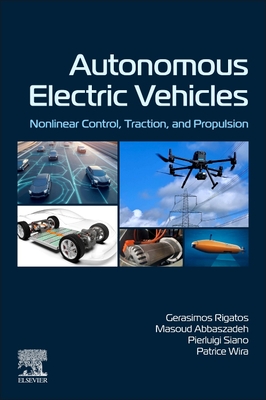
Autonomous Electric Vehicles: Nonlinear Control, Traction, and Propulsion
| AUTHOR | Abbaszadeh, Masoud; Rigatos, Gerasimos; Rigatos, Gerasimo et al. |
| PUBLISHER | Elsevier (05/30/2025) |
| PRODUCT TYPE | Paperback (Paperback) |
Description
Autonomous Electric Vehicles explores cutting-edge technologies revolutionizing transportation and city navigation. Novel solutions to the control problem of the complex nonlinear dynamics of robotized electric vehicles are developed and tested. The new control methods are free of shortcomings met in control schemes which are based on diffeomorphisms and global linearization (complicated changes of state variables, forward and backwards state-space transformations, singularities). It is shown that such methods can be used in the steering and traction system of several types of robotized electric vehicles without needing to transform the state-space model of these systems into equivalent linearized forms. It is also shown that the new control methods can be implemented in a computationally simple manner and are also followed by global stability proofs.
Show More
Product Format
Product Details
ISBN-13:
9780443288548
ISBN-10:
0443288542
Binding:
Paperback or Softback (Trade Paperback (Us))
Content Language:
English
More Product Details
Page Count:
660
Carton Quantity:
12
Product Dimensions:
6.27 x 1.23 x 8.93 inches
Weight:
2.33 pound(s)
Country of Origin:
US
Subject Information
BISAC Categories
Technology & Engineering | Automotive
Technology & Engineering | Robotics
Technology & Engineering | Artificial Intelligence - General
Descriptions, Reviews, Etc.
publisher marketing
Autonomous Electric Vehicles explores cutting-edge technologies revolutionizing transportation and city navigation. Novel solutions to the control problem of the complex nonlinear dynamics of robotized electric vehicles are developed and tested. The new control methods are free of shortcomings met in control schemes which are based on diffeomorphisms and global linearization (complicated changes of state variables, forward and backwards state-space transformations, singularities). It is shown that such methods can be used in the steering and traction system of several types of robotized electric vehicles without needing to transform the state-space model of these systems into equivalent linearized forms. It is also shown that the new control methods can be implemented in a computationally simple manner and are also followed by global stability proofs.
Show More
Your Price
$267.30