
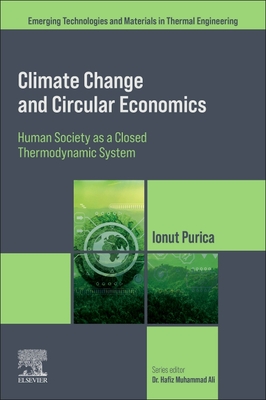
Climate Change and Circular Economics: Human Society as a Closed Thermodynamic System
| AUTHOR | Purica, Ionut |
| PUBLISHER | Elsevier (06/25/2024) |
| PRODUCT TYPE | Paperback (Paperback) |
Description
Climate Change and Circular Economics: Human Society as a Closed Thermodynamic System aims to go beyond the concept of 'fighting climate change' to analyze the capacity of human society to evolve in relation to the environment based on a more complex approach. The book stresses the role of resource recovery by innovation in reducing the temperature increase, determined through an irreversible thermodynamic approach. Determining the speed of temperature increase contributed by selected economies and comparing these to environmental recovery time constants shows that emerging economies have a much greater speed and consequently a larger impact on environmental capability to recover. Chapters progress from an analysis of present society as a dissipative open system to a thermodynamics view of the need for a circular economy, a big data analysis of climate change and risk mitigation, economic indicators, including entropy and economics, risk maps of climate change events risks, and insights into the 'Gibbs paradox', which describes the connection of two separate systems (like society and environment).
Show More
Product Format
Product Details
ISBN-13:
9780443299698
ISBN-10:
0443299692
Binding:
Paperback or Softback (Trade Paperback (Us))
Content Language:
English
More Product Details
Page Count:
304
Carton Quantity:
27
Country of Origin:
US
Subject Information
BISAC Categories
Technology & Engineering | Power Resources - Alternative & Renewable
Technology & Engineering | Energy
Descriptions, Reviews, Etc.
publisher marketing
Climate Change and Circular Economics: Human Society as a Closed Thermodynamic System aims to go beyond the concept of 'fighting climate change' to analyze the capacity of human society to evolve in relation to the environment based on a more complex approach. The book stresses the role of resource recovery by innovation in reducing the temperature increase, determined through an irreversible thermodynamic approach. Determining the speed of temperature increase contributed by selected economies and comparing these to environmental recovery time constants shows that emerging economies have a much greater speed and consequently a larger impact on environmental capability to recover. Chapters progress from an analysis of present society as a dissipative open system to a thermodynamics view of the need for a circular economy, a big data analysis of climate change and risk mitigation, economic indicators, including entropy and economics, risk maps of climate change events risks, and insights into the 'Gibbs paradox', which describes the connection of two separate systems (like society and environment).
Show More
List Price $160.00
Your Price
$158.40