
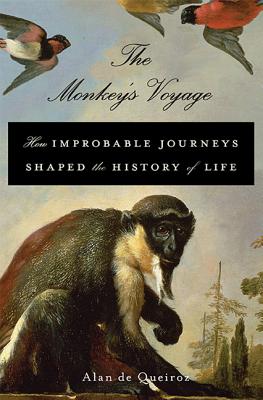
The Monkey's Voyage: How Improbable Journeys Shaped the History of Life
| AUTHOR | De Queiroz, Alan |
| PUBLISHER | Basic Books (01/07/2014) |
| PRODUCT TYPE | Hardcover (Hardcover) |
Description
Throughout the world, closely related species are found on landmasses separated by wide stretches of ocean. What explains these far-flung distributions? Why are such species found where they are across the Earth? Since the discovery of plate tectonics, scientists have conjectured that plants and animals were scattered over the globe by riding pieces of ancient supercontinents as they broke up. In the past decade, however, that theory has foundered, as the genomic revolution has made reams of new data available. And the data has revealed an extraordinary, stranger-than-fiction story that has sparked a scientific upheaval. In The Monkey's Voyage, biologist Alan de Queiroz describes the radical new view of how fragmented distributions came into being: frogs and mammals rode on rafts and icebergs, tiny spiders drifted on storm winds, and plant seeds were carried in the plumage of sea-going birds to create the map of life we see today. In other words, these organisms were not simply constrained by continental fate; they were the makers of their own geographic destiny. And as de Queiroz shows, the effects of oceanic dispersal have been crucial in generating the diversity of life on Earth, from monkeys and guinea pigs in South America to beech trees and kiwi birds in New Zealand. By toppling the idea that the slow process of continental drift is the main force behind the odd distributions of organisms, this theory highlights the dynamic and unpredictable nature of the history of life. In the tradition of John McPhee's Basin and Range, The Monkey's Voyage is a beautifully told narrative that strikingly reveals the importance of contingency in history and the nature of scientific discovery.
Show More
Product Format
Product Details
ISBN-13:
9780465020515
ISBN-10:
0465020518
Binding:
Hardback or Cased Book (Sewn)
Content Language:
English
More Product Details
Page Count:
368
Carton Quantity:
24
Product Dimensions:
6.10 x 1.40 x 9.30 inches
Weight:
1.30 pound(s)
Feature Codes:
Bibliography,
Index,
Price on Product - Canadian,
Dust Cover,
Price on Product,
Maps,
Table of Contents,
Illustrated
Country of Origin:
US
Subject Information
BISAC Categories
Science | Life Sciences - Biological Diversity
Science | Natural History
Science | Life Sciences - Evolution
Dewey Decimal:
570
Library of Congress Control Number:
2013036248
Descriptions, Reviews, Etc.
publisher marketing
Throughout the world, closely related species are found on landmasses separated by wide stretches of ocean. What explains these far-flung distributions? Why are such species found where they are across the Earth? Since the discovery of plate tectonics, scientists have conjectured that plants and animals were scattered over the globe by riding pieces of ancient supercontinents as they broke up. In the past decade, however, that theory has foundered, as the genomic revolution has made reams of new data available. And the data has revealed an extraordinary, stranger-than-fiction story that has sparked a scientific upheaval. In The Monkey's Voyage, biologist Alan de Queiroz describes the radical new view of how fragmented distributions came into being: frogs and mammals rode on rafts and icebergs, tiny spiders drifted on storm winds, and plant seeds were carried in the plumage of sea-going birds to create the map of life we see today. In other words, these organisms were not simply constrained by continental fate; they were the makers of their own geographic destiny. And as de Queiroz shows, the effects of oceanic dispersal have been crucial in generating the diversity of life on Earth, from monkeys and guinea pigs in South America to beech trees and kiwi birds in New Zealand. By toppling the idea that the slow process of continental drift is the main force behind the odd distributions of organisms, this theory highlights the dynamic and unpredictable nature of the history of life. In the tradition of John McPhee's Basin and Range, The Monkey's Voyage is a beautifully told narrative that strikingly reveals the importance of contingency in history and the nature of scientific discovery.
Show More
Your Price
$34.65