
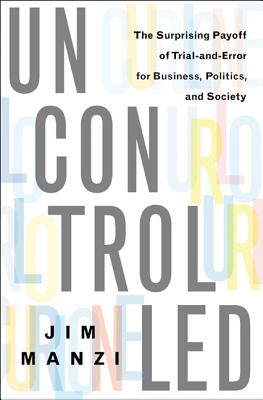
Uncontrolled: The Surprising Payoff of Trial-And-Error for Business, Politics, and Society
| AUTHOR | Manzi, Jim |
| PUBLISHER | Basic Books (05/01/2012) |
| PRODUCT TYPE | Hardcover (Hardcover) |
Description
How do we know which social and economic policies work, which should be continued, and which should be changed? Jim Manzi argues that throughout history, various methods have been attempted -- except for controlled experimentation. Experiments provide the feedback loop that allows us, in certain limited ways, to identify error in our beliefs as a first step to correcting them. Over the course of the first half of the twentieth century, scientists invented a methodology for executing controlled experiments to evaluate certain kinds of proposed social interventions. This technique goes by many names in different contexts (randomized control trials, randomized field experiments, clinical trials, etc.). Over the past ten to twenty years this has been increasingly deployed in a wide variety of contexts, but it remains the red-haired step child of modern social science. This is starting to change, and this change should be encouraged and accelerated, even though the staggering complexity of human society creates severe limits to what social science could be realistically expected to achieve. Randomized trials have shown, for example, that work requirements for welfare recipients have succeeded like nothing else in encouraging employment, that charter school vouchers have been successful in increasing educational attainment for underprivileged children, and that community policing has worked to reduce crime, but also that programs like Head Start and Job Corps, which might be politically attractive, fail to attain their intended objectives. Business leaders can also use experiments to test decisions in a controlled, low-risk environment before investing precious resources in large-scale changes -- the philosophy behind Manzi's own successful software company. In a powerful and masterfully-argued book, Manzi shows us how the methods of science can be applied to social and economic policy in order to ensure progress and prosperity.
Show More
Product Format
Product Details
ISBN-13:
9780465023240
ISBN-10:
046502324X
Binding:
Hardback or Cased Book (Sewn)
Content Language:
English
More Product Details
Page Count:
320
Carton Quantity:
18
Product Dimensions:
6.40 x 1.20 x 9.30 inches
Weight:
1.14 pound(s)
Feature Codes:
Bibliography,
Index,
Dust Cover,
Price on Product,
Illustrated
Country of Origin:
US
Subject Information
BISAC Categories
Science | Philosophy & Social Aspects
Science | Research
Science | Methodology
Grade Level:
College Freshman
and up
Dewey Decimal:
001.434
Library of Congress Control Number:
2012004409
Descriptions, Reviews, Etc.
publisher marketing
How do we know which social and economic policies work, which should be continued, and which should be changed? Jim Manzi argues that throughout history, various methods have been attempted -- except for controlled experimentation. Experiments provide the feedback loop that allows us, in certain limited ways, to identify error in our beliefs as a first step to correcting them. Over the course of the first half of the twentieth century, scientists invented a methodology for executing controlled experiments to evaluate certain kinds of proposed social interventions. This technique goes by many names in different contexts (randomized control trials, randomized field experiments, clinical trials, etc.). Over the past ten to twenty years this has been increasingly deployed in a wide variety of contexts, but it remains the red-haired step child of modern social science. This is starting to change, and this change should be encouraged and accelerated, even though the staggering complexity of human society creates severe limits to what social science could be realistically expected to achieve. Randomized trials have shown, for example, that work requirements for welfare recipients have succeeded like nothing else in encouraging employment, that charter school vouchers have been successful in increasing educational attainment for underprivileged children, and that community policing has worked to reduce crime, but also that programs like Head Start and Job Corps, which might be politically attractive, fail to attain their intended objectives. Business leaders can also use experiments to test decisions in a controlled, low-risk environment before investing precious resources in large-scale changes -- the philosophy behind Manzi's own successful software company. In a powerful and masterfully-argued book, Manzi shows us how the methods of science can be applied to social and economic policy in order to ensure progress and prosperity.
Show More
Your Price
$36.63