
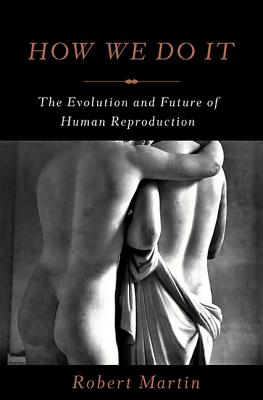
How We Do It: The Evolution and Future of Human Reproduction
| AUTHOR | Martin, Robert |
| PUBLISHER | Basic Books (06/11/2013) |
| PRODUCT TYPE | Hardcover (Hardcover) |
Description
Despite the widespread belief that natural is better when it comes to sex, pregnancy, and parenting, most of us have no idea what "natural" really means; the origins of our reproductive lives remain a mystery. Why are a quarter of a billion sperm cells needed to fertilize one egg? Are women really fertile for only a few days each month? How long should babies be breast-fed? In How We Do It, primatologist Robert Martin draws on forty years of research to locate the roots of everything from our sex cells to the way we care for newborns. He examines the procreative history of humans as well as that of our primate kin to reveal what's really natural when it comes to making and raising babies, and distinguish which behaviors we ought to continue -- and which we should not. Although it's not realistic to raise our children like our ancestors did, Martin's investigation reveals surprising consequences of -- and suggests ways to improve upon -- the way we do things now. For instance, he explains why choosing a midwife rather than an obstetrician may have a greater impact than we think on our birthing experience, examines the advantages of breast-feeding for both mothers and babies, and suggests why babies may be ready for toilet training far earlier than is commonly practiced. How We Do It offers much-needed context for our reproductive and child-rearing practices, and shows that once we understand our evolutionary past, we can consider what worked, what didn't't, and what it all means for the future of our species.
Show More
Product Format
Product Details
ISBN-13:
9780465030156
ISBN-10:
0465030157
Binding:
Hardback or Cased Book (Sewn)
Content Language:
English
More Product Details
Page Count:
320
Carton Quantity:
18
Product Dimensions:
6.20 x 1.20 x 9.40 inches
Weight:
1.20 pound(s)
Feature Codes:
Bibliography,
Index,
Price on Product - Canadian,
Dust Cover,
Price on Product,
Table of Contents,
Glossary
Country of Origin:
US
Subject Information
BISAC Categories
Science | Life Sciences - Evolution
Science | Life Sciences - Human Anatomy & Physiology
Science | Life Sciences - Zoology - Primatology
Dewey Decimal:
612.6
Descriptions, Reviews, Etc.
publisher marketing
Despite the widespread belief that natural is better when it comes to sex, pregnancy, and parenting, most of us have no idea what "natural" really means; the origins of our reproductive lives remain a mystery. Why are a quarter of a billion sperm cells needed to fertilize one egg? Are women really fertile for only a few days each month? How long should babies be breast-fed? In How We Do It, primatologist Robert Martin draws on forty years of research to locate the roots of everything from our sex cells to the way we care for newborns. He examines the procreative history of humans as well as that of our primate kin to reveal what's really natural when it comes to making and raising babies, and distinguish which behaviors we ought to continue -- and which we should not. Although it's not realistic to raise our children like our ancestors did, Martin's investigation reveals surprising consequences of -- and suggests ways to improve upon -- the way we do things now. For instance, he explains why choosing a midwife rather than an obstetrician may have a greater impact than we think on our birthing experience, examines the advantages of breast-feeding for both mothers and babies, and suggests why babies may be ready for toilet training far earlier than is commonly practiced. How We Do It offers much-needed context for our reproductive and child-rearing practices, and shows that once we understand our evolutionary past, we can consider what worked, what didn't't, and what it all means for the future of our species.
Show More
Author:
Martin, Robert
Robert Martin is an Assistant Professor of Sociology at Southeastern Louisiana University.
Show More
Your Price
$36.63