
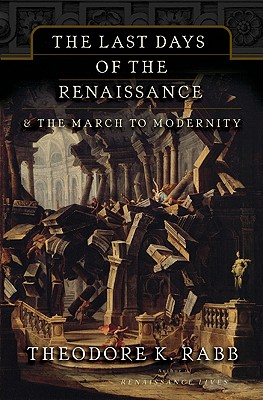
The Last Days of the Renaissance: & the March to Modernity
| AUTHOR | Rabb, Theodore K. |
| PUBLISHER | Basic Books (06/12/2007) |
| PRODUCT TYPE | Paperback (Paperback) |
Description
There is little debate that the Renaissance began at the end of the fourteenth century. Its end, though, is much more difficult to pin down. Here, for the first time, renowned classicist Theodore Rabb defines the changes that marked the shift away from the Renaissance to Modernity, and explains why these changes took place. The European Renaissance is usually characterized by the belief that a distinct antique civilization represented the ideal for all human endeavors. But there were other unities that defined the era: a shift in the role of the aristocracy from a warrior class to a cultural elite, a growth in education, a more thoughtful probing into the sciences, and the use of the arts for nonreligious purposes. By the dawn of the seventeenth century, four developments had swept over the world, altering these unities and ending the Renaissance: a break with the period's obsession with the past, which invited openness to innovation; a quest for central political control to cure increasing instability; a change in direction of people's passion and enthusiasm; and a new commitment to reason. With thoughtful, wide-lens scholarship and close, detailed looks throughout at the significant moments of change, Rabb offers us a radically new understanding of one of the most pivotal shifts in modern history.
Show More
Product Format
Product Details
ISBN-13:
9780465068029
ISBN-10:
0465068022
Binding:
Paperback or Softback (Trade Paperback (Us))
Content Language:
English
More Product Details
Page Count:
280
Carton Quantity:
24
Product Dimensions:
5.47 x 0.72 x 7.88 inches
Weight:
0.66 pound(s)
Feature Codes:
Bibliography,
Index,
Price on Product - Canadian,
Price on Product,
Table of Contents,
Illustrated
Country of Origin:
US
Subject Information
BISAC Categories
History | Europe - General
History | World - General
Grade Level:
College Freshman
and up
Dewey Decimal:
940.21
Descriptions, Reviews, Etc.
publisher marketing
There is little debate that the Renaissance began at the end of the fourteenth century. Its end, though, is much more difficult to pin down. Here, for the first time, renowned classicist Theodore Rabb defines the changes that marked the shift away from the Renaissance to Modernity, and explains why these changes took place. The European Renaissance is usually characterized by the belief that a distinct antique civilization represented the ideal for all human endeavors. But there were other unities that defined the era: a shift in the role of the aristocracy from a warrior class to a cultural elite, a growth in education, a more thoughtful probing into the sciences, and the use of the arts for nonreligious purposes. By the dawn of the seventeenth century, four developments had swept over the world, altering these unities and ending the Renaissance: a break with the period's obsession with the past, which invited openness to innovation; a quest for central political control to cure increasing instability; a change in direction of people's passion and enthusiasm; and a new commitment to reason. With thoughtful, wide-lens scholarship and close, detailed looks throughout at the significant moments of change, Rabb offers us a radically new understanding of one of the most pivotal shifts in modern history.
Show More
Author:
Rabb, Theodore K.
Theodore K. Rabb is Professor of History at Princeton University. He is the author of "Renaissance Lives", "The Struggle for Stability in Early Modern Europe", and "Enterprise and Empire". He coedited (with Robert I. Rotberg) "Climate and History" and "The New History" (Princeton).
Show More
Your Price
$21.77