
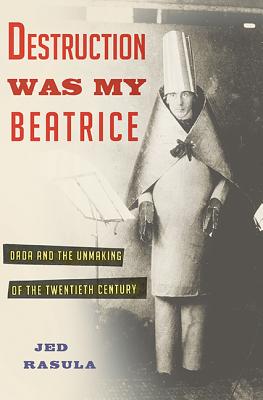
Destruction Was My Beatrice: Dada and the Unmaking of the Twentieth Century
| AUTHOR | Rasula, Jed |
| PUBLISHER | Basic Books (06/02/2015) |
| PRODUCT TYPE | Hardcover (Hardcover) |
Description
In 1916, as World War I raged around them, a group of bohemians gathered at a small cabaret in Zurich, Switzerland. After decorating the walls with art by Picasso and other avant-garde artists, they embarked on a series of extravagant performances. Three readers simultaneously recited a poem in three languages; a monocle-wearing teenager performed a spell from New Zealand; another young man sneered at the audience, snapping a whip as he intoned his Fantastic Prayers. One of the artists called these sessions both buffoonery and a requiem mass. Soon they would have a more evocative name: Dada.
In "Destruction Was My Beatrice," modernist scholar Jed Rasula presents the first narrative history of Dada, showing how this little-understood artistic phenomenon laid the foundation for culture as we know it today. Although the venue where Dada was born closed after only four months and its acolytes scattered, the idea of Dada quickly spread to New York, where it influenced artists like Marcel Duchamp and Man Ray; to Berlin, where it inspired painters George Grosz and Hannah Hoch; and to Paris, where it dethroned previous avant-garde movements like Fauvism and Cubism while inspiring early Surrealists like Andre Breton, Louis Aragon, and Paul Eluard. The long tail of Dadaism, Rasula shows, can be traced even further, to artists as diverse as William S. Burroughs, Robert Rauschenberg, Marshall McLuhan, the Beatles, Monty Python, David Byrne, and Jean-Michel Basquiat, all of whomalong with untold othersowe a debt to the bizarre wartime escapades of the Dada vanguard.
A globe-spanning narrative that resurrects some of the 20th century s most influential artistic figures, "Destruction Was My Beatrice" describes how Dada burst upon the world in the midst of total warand how the effects of this explosion are still reverberating today.
"
In "Destruction Was My Beatrice," modernist scholar Jed Rasula presents the first narrative history of Dada, showing how this little-understood artistic phenomenon laid the foundation for culture as we know it today. Although the venue where Dada was born closed after only four months and its acolytes scattered, the idea of Dada quickly spread to New York, where it influenced artists like Marcel Duchamp and Man Ray; to Berlin, where it inspired painters George Grosz and Hannah Hoch; and to Paris, where it dethroned previous avant-garde movements like Fauvism and Cubism while inspiring early Surrealists like Andre Breton, Louis Aragon, and Paul Eluard. The long tail of Dadaism, Rasula shows, can be traced even further, to artists as diverse as William S. Burroughs, Robert Rauschenberg, Marshall McLuhan, the Beatles, Monty Python, David Byrne, and Jean-Michel Basquiat, all of whomalong with untold othersowe a debt to the bizarre wartime escapades of the Dada vanguard.
A globe-spanning narrative that resurrects some of the 20th century s most influential artistic figures, "Destruction Was My Beatrice" describes how Dada burst upon the world in the midst of total warand how the effects of this explosion are still reverberating today.
"
Show More
Product Format
Product Details
ISBN-13:
9780465089963
ISBN-10:
0465089968
Binding:
Hardback or Cased Book (Sewn)
Content Language:
English
More Product Details
Page Count:
384
Carton Quantity:
24
Product Dimensions:
6.10 x 1.50 x 9.40 inches
Weight:
1.30 pound(s)
Feature Codes:
Bibliography,
Index,
Price on Product,
Illustrated
Country of Origin:
US
Subject Information
BISAC Categories
Art | Movements - Modernism
Art | Popular Culture
Art | Artists, Architects, Photographers
Dewey Decimal:
700.411
Library of Congress Control Number:
2015004226
Descriptions, Reviews, Etc.
publisher marketing
In 1916, as World War I raged around them, a group of bohemians gathered at a small cabaret in Zurich, Switzerland. After decorating the walls with art by Picasso and other avant-garde artists, they embarked on a series of extravagant performances. Three readers simultaneously recited a poem in three languages; a monocle-wearing teenager performed a spell from New Zealand; another young man sneered at the audience, snapping a whip as he intoned his Fantastic Prayers. One of the artists called these sessions both buffoonery and a requiem mass. Soon they would have a more evocative name: Dada.
In "Destruction Was My Beatrice," modernist scholar Jed Rasula presents the first narrative history of Dada, showing how this little-understood artistic phenomenon laid the foundation for culture as we know it today. Although the venue where Dada was born closed after only four months and its acolytes scattered, the idea of Dada quickly spread to New York, where it influenced artists like Marcel Duchamp and Man Ray; to Berlin, where it inspired painters George Grosz and Hannah Hoch; and to Paris, where it dethroned previous avant-garde movements like Fauvism and Cubism while inspiring early Surrealists like Andre Breton, Louis Aragon, and Paul Eluard. The long tail of Dadaism, Rasula shows, can be traced even further, to artists as diverse as William S. Burroughs, Robert Rauschenberg, Marshall McLuhan, the Beatles, Monty Python, David Byrne, and Jean-Michel Basquiat, all of whomalong with untold othersowe a debt to the bizarre wartime escapades of the Dada vanguard.
A globe-spanning narrative that resurrects some of the 20th century s most influential artistic figures, "Destruction Was My Beatrice" describes how Dada burst upon the world in the midst of total warand how the effects of this explosion are still reverberating today.
"
In "Destruction Was My Beatrice," modernist scholar Jed Rasula presents the first narrative history of Dada, showing how this little-understood artistic phenomenon laid the foundation for culture as we know it today. Although the venue where Dada was born closed after only four months and its acolytes scattered, the idea of Dada quickly spread to New York, where it influenced artists like Marcel Duchamp and Man Ray; to Berlin, where it inspired painters George Grosz and Hannah Hoch; and to Paris, where it dethroned previous avant-garde movements like Fauvism and Cubism while inspiring early Surrealists like Andre Breton, Louis Aragon, and Paul Eluard. The long tail of Dadaism, Rasula shows, can be traced even further, to artists as diverse as William S. Burroughs, Robert Rauschenberg, Marshall McLuhan, the Beatles, Monty Python, David Byrne, and Jean-Michel Basquiat, all of whomalong with untold othersowe a debt to the bizarre wartime escapades of the Dada vanguard.
A globe-spanning narrative that resurrects some of the 20th century s most influential artistic figures, "Destruction Was My Beatrice" describes how Dada burst upon the world in the midst of total warand how the effects of this explosion are still reverberating today.
"
Show More
Author:
Rasula, Jed
Jed Rasula is the author of Tabula Rasula: being a book of audible visual matters (1986), editor of the poetry magazine Wch Way (1976-83), and concocted Imagining Language with Steve McCaffery 1998). Author also of numerous scholarly books and articles, Rasula taught at Queen's University in Kingston Ontario from 1990-2001, departing (unsuccessfully) on September 11, 2001, to take up his current position as Helen S. Lanier Distinguished Professor at the University of Georgia, deep (very deep) in the Bible Belt.
Show More
Your Price
$34.65